
Abstract
The Rigveda and later ancient Indian texts mention distant lands where Indra performed great deeds, where gods, bards and demons lived, where the Sun, waters and cows were set free. This paper analyses the correspondence between places proposed as the location for the events described and the characteristics given in the Rigveda, using linguistic, geographical, climatic and astronomical data, examining alternative territories meeting the criteria defined in the paper where the people may have lived whose impressions developed into the legends that became the basis of the hymns in the Rigveda and other texts of the ancient Indian epos.
Keywords: Rigveda, Indra, Vr̥tra, Uṣas, sapta-sindhavaḥ, Sarasvatī, Ṛta, Arctic theory.
Introduction
In Hinduism’s most ancient poetic work, the Rigveda,[1] one can find verses describing distant lands where the gods established the principle of cosmic order, the Law[2], according to which night should give way to dawn, the sun rise and set. It was there that the gods and Angiras poets lived, that the thunderbolt-wielding Indra performed his heroic deeds. The description of those lands, however, causes difficulty in the identification of the locations where the events of which the legends tell took place.
Did legends more ancient than the Rigveda exist that then became the basis for the creation of its hymns? At the turn of the 20th century there was widespread recognition among scholars for the theory of ākhyāna (literally “narrative”)[3] which was based on the thinking of Hermann Oldenberg.[4] That theory proposed the existence of a no longer extant narrative foundation for the poetic part of the Rigveda. Critics suggested that the theory was too speculative. In particular, A. Berriedale Keith[5] pointed out that in the later Brahmanas prose elements survived along with the verses, while there are none in the Rigveda. Later, Jan Gonda[6], summarizing the oldest and more recent texts, suggested that by the time of the Rigveda’s creation a generally accepted collection of legends and myths about ancient times had already formed and the poets of the Rigveda took inspiration from it. Over time, however, a long chain of storyteller-listener links led to changes in the narrative parts of the Indian epos, while the poetic sections remained unaltered, which resulted in many discrepancies between the versions of myths and legends in the Puranas and the Rigveda.
It follows that either the Rigveda legends had a basis bound up with people’s perception of the world around them or else the subject matter was invented and based solely upon the mystic experience of its creators. The present study is founded on the concept of a naturalistic interpretation of the stories in the Rigveda – the suggestion that they were based on people’s interpretation of natural phenomena and geographical features around them.
In other words, we propose that the Rigveda as a “body” consists of a “skeleton” created on the basis of people’s perception of their surrounding reality upon which there then accumulated an associative-allegorical layer of “soft tissues”, while onto that, in turn, a “covering of skin” was applied – the actual hymns addressed to the gods.
Geography
From the legends on whose plots a large number of the Rigveda’s hymns are based, its narrative foundation, we can extract accounts of a landscape.
- There are descriptions of mountains with at least eight summits[7].
- Mention is made of three (or two times three, as grammatically trī is in the dual form) adjoining desolate plains[8]. The reference in verse II.13.10 to “six broad expanses”[9] may also be about these.
- There is talk of a large number of medium- and small-sized rivers, as well as streams. According to I.62.10: “From of old the streams coming from the same nest, unquenchable and immortal, guard their commandments with their powers. Many thousands of sisters, like married women, offer friendship to the unabashed one.”[10]
- Ninety of those rivers are navigable[11].
- There are seven great rivers[12], the names of which are listed in verse Х.75.5. They are the Gaṅgā, Yamunā, Sarasvatī, Śutudrī, Paruṣṇī, Marudvr̥dhā and Ārjīkīyā. Separate mention is made of the Sindhu, a word which can be both a proper and a common noun. In the latter case, sindhu may refer to one or any of the great rivers previously mentioned.
- At least one of the great rivers flows towards the north, as this is stated in II.15.6: “By his greatness he [Indra] made the Sindhu to flow northward.”[13]
- Two seas are mentioned, one to the west, the other to the east.[14]Also verse 1:6:3:11 of the Shatapatha Brahmana states that the serpent-like Vṛtra, who is mentioned repeatedly in the Rigveda, pushed back the western and eastern seas. The geographical picture painted requires the presence of mountains and plains, as well as seven great rivers, with seas located nearby, one to the west, another to the east.
These physical features do not entirely accord with the characteristics of the region in the north of the Indian subcontinent, where the Gaṅgā (Ganges), Yamunā (Jumna) and Sindhu (Indus) flow. Specifically:
- The six broad expanses are unknown.
- Only two great rivers are named. Information about the location of the Sarasvati, the largest of the rivers in the Rigveda, as well as of the remaining four, has been lost.
In order to identify the territory in question, researchers of the Rigveda have drawn on knowledge from various fields of leaning, including linguistics.
The Linguistic (Punjab) Theory
In 1930 Lachhmi Dhar Kalla[15] formulated a theory founded on an analysis of the linguistic characteristics of the language of the Rigveda compared to those of other Indo-Aryan languages and dialects. He determined that the greatest number of correspondence with Vedic Sanskrit can be observed in the languages of the inhabitants of the Punjab, a region spanning present-day India and Pakistan. On this basis, the conclusion was drawn that the location where the texts of the Rigveda were created is the territory of Punjab and that it was there and close by that the events described took place.
When developing the Punjab linguistic theory further, scholars analysed the rivers flowing through the proposed territory, making attempts to draw parallels with the designations of rivers in the Rigveda so as to identify them. The blocking of the rivers by the serpent Vṛtra described in the Rigveda was viewed as glaciers descending into the valleys of the rivers.[16] Rivers named Gaṅgā and Yamunā in Sanskrit can still be found on the map of India.
In the Rigveda, the best river of all is the mother goddess Sarasvati[17]. It stands out from the other rivers and flows pure from the mountains to the sea[18]. The Sarasvati’s mighty flow is described as an endless, undeviating, dangerous, mobile, turbulent flood that rushes along with a great roar[19].
In the hymns of the Rigveda, the Sarasvati is mentioned together with the Sindhu. The location of the Sindhu is known – it is the River Indus that flows through India and Pakistan, but the whereabouts of the Sarasvati have not been established for certain. Taking account of the linguistic theory and the present disposition of some of the rivers mentioned in the Rigveda, researchers identify the Sarasvati with various present-day rivers – either the Sindhu (Indus), or the Ghaggar-Hakra-Nara, or the Arghandab.
Without going into a detailed analysis of the different versions for the localization of the Sarasvati, we would note the main contradiction between these hypotheses and the values of Hinduism, which is that the whereabouts of the river goddess Sarasvati, the most venerated of the rivers described in the Rigveda, became lost despite an unbroken religious tradition enduring for thousands of years – a tradition that created a unique system for passing on religious texts containing several thousand verses word for word, that displayed great resistance to random changes. It is impossible to imagine the location of the river-goddess Sarasvati being forgotten at the same time as the meticulous preservation of the religious-cultural (literary) tradition of passing on texts by word of mouth across dozens of generations, from the Rigveda’s authors to present-day Brahmans. The most likely-seeming scenario is that the followers of the Vedic religion ended up far away from the Sarasvati for a long period of time and that was what led to its location being forgotten. This is why in the search for the places described in the stories of the Rigveda it is proposed to also consider other parts of Eurasia, including ones inaccessible to the Brahmans.
The Periodicity of Events
Let us analyse additional characteristics of the territories associated with a succession of time periods about which legends may have reached the poets of the Rigveda. The serpent Vṛtra halts the flow of rivers and blocks the waters spilt out across the surface of the earth, which Vṛtra’s opponent, the hero god Indra, then goes on to release. The Sun is also released, as are the cows shut up at Vṛtra’s instigation. References to these episodes occur throughout the entire text of the Rigveda.
Despite the fact that in the overwhelming majority of hymns the great deeds of the gods take place in the past, in certain instances the Rigveda uses a special archaic mood of the verb – the injunctive, which does not convey the grammatical category of tense (and thus time).[20] Sometimes Indra’s deeds are described in both past and future tenses, which prompts a hypothesis about the recurrence of the events.
“The bullish draught exhilarated you — the soma, brought here by a falcon, then pressed, with its aid you smashed Vr̥tra forth from the waters, o Thunderer, with your might. – They cheer on [your] sovereign power.”[21]
“Go forth! Go to it! Dare! Your mace will not be restrained, for, Indra, manly power and strength are yours. You will smash Vr̥tra; you will conquer the waters.’ – They cheer on [your] sovereign power.”[22]
The natural phenomena take place during three main time periods. The first sees the rivers ceasing to flow (bound up or blocked), the disappearance of the Sun and cows. The second period is associated with the absence of the Sun and cows, the rivers failing to flow. In the third, the rivers, Sun and cows are released.
“Surya [the Sun] has spread his light as splendour; the cows’ mother [Dawn] has come forth, knowing the way; the rivers flow with running waters, washing away their banks…”[23]
The rivers washing away their banks was probably due to either heavy rains or the melting of the snows in springtime. Both the one and the other might be considered as the release of the rivers described in the Rigveda.
“Having slain Vr̥tra, he set the rivers free for many dawns[/days] and autumns[/years]. Indra released the contained, hard-pressed streams to flow across the earth.”[24]
Possible interpretations: the rivers are released
- every day throughout the year
- every day of śarad, the two-month autumn season
- every year at some particular dawn
All three interpretations presume that the action takes place over the course of many years. However, the version of a daily cycle entails a fundamental contradiction – the appearance and removal of blockages on rivers cannot occur every day, unlike the rising and setting of the Sun, or cattle leaving and returning to their enclosure.
Also of interest in the search for arguments in favour of an annual cycle for the events described in the Rigveda is the cosmogonic hymn X.190, which contains just three verses.
- Both Law and Truth were born from heat when it was kindled. From that, night was born, and from that the undulating sea.[25]
- From the undulating sea was born the year, which distributes the days and nights and exerts its will over all who blinks [=mortals].[26]
- The Ordainer formed, as before, a pair of measures [of time, probably months] of the non-shining Sun, heaven and earth, the region between, and then sunlight.[27]
According to this narrative, a night is first created that does not give way to days, followed by the year that distributes days and nights, in the process of which a non-shining sun, heaven and earth are formed, as well as the region of air between them, and then the Ordainer produces sunlight.
We should note the possibility that the occurrence of the first day of the year being created (X.190.2) is not accompanied by sunlight, the initial appearance of which is indicated only in X.190.3. It would seem that these two events ought to be simultaneous, but in this text that is not the case. We can conjecture that the year distributing days and nights (X.190.2) is created, as before. Thus the events are described as recurrent, as having happened previously. Neither is there an indication of some specific year to which this applies, so it is possible to assume that it applies to every year.
This hymn illustrates on the one hand the periodical nature of astronomical processes, and on the other the recurrence of the birth of the year. An interesting aspect is the description of a night without days before the birth of the year. At the end of the paper, we shall propose a version that explains this anomaly.
A further argument in support of the idea of the annual recurrence of the events described in the Rigveda might be the indication in verse I.131.4 that the serpent Vṛtra’s fortresses or ramparts, which Indra smashes, are termed autumnal (śāradīr), that is to say, annual, since by Indian tradition years are counted by autumns (in a similar way to “summers” in other traditions, including English). It seems likely that the events described in verse IV.19.8 cited above, with the rivers being released through many dawns and autumns, also took place every year.
The Surroundings of the Sun
Let us analyse the Rigveda’s description of the beings and objects surrounding the Sun.
In the text of the epos, Sūrya the Sun does not act alone when moving across the heavens. He has assistants – a pair of twin charioteers, the Ashvins (aśvinā) or Nasatyas (nāsatyau), who help him to handle his chariot. Sometimes they are joined by the daughter of the Sun, Sūryaa.[28]
For the most part, two means of motion are indicated for the Sun in the Rigveda. He/It either has a single wheel which is pulled by a certain Etaśa[29], or else the Sun is conveyed in a three-person chariot with three wheels.[30] The chariot might be drawn by seven- fiery yellow-red horses.[31]
The difference between these means of transport and ordinary two-wheeled chariots or four-wheeled carriages is not clear. We shall attempt to examine possible connections with effects visible in the firmament that would have been awe-inspiring for humans in ancient times.
Various optical phenomena can be observed in the atmosphere in association with the Sun – the solar halos and parhelia (Fig. 1). These effects are the result of sunlight being refracted through clouds, mainly belonging to the cirrostratus or cirrus classes.[32]
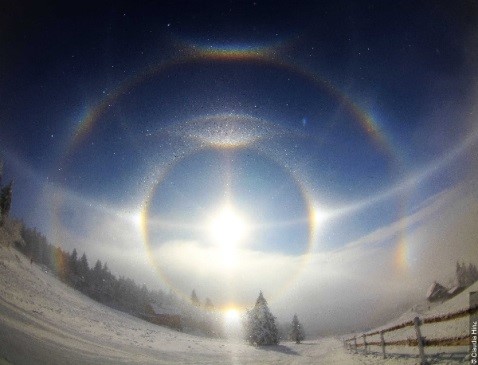
Fig. 1
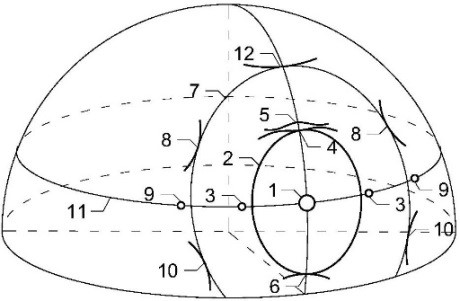
Fig. 2
Diagram showing the positions of halo and parhelic phenomena
Key
- Sun
- small (22º) halo
- parhelia of the small halo
- upper tangent arc
- Parry arc
- lower tangent arc
- large (46º) halo
- superlateral arc
- paranthelia of the large halo
- infralateral arcs
- parhelic circle
- circumzenithal arc
The commonest type of halo is a circle 22° out from the Sun and is known as a small halo. The large halo, 46° out, is less visible and occurs less often. The brightest and most frequently encountered phenomena are parhelia (mock suns or sun dogs), which take the form of two symmetrical clusters of light to the left and right of the Sun itself at a distance of just over 22°. An arc may appear on the top of the small halo with its middle curving downwards – that is called the upper tangent arc. Another, curving upwards on the bottom of the halo, is the lower tangent arc. The Parry arc is located above the upper tangent arc and curves upwards. The lower tangent arc does not always appear on the small halo. It becomes visible when the Sun rises more than 22°degrees above the horizon. While four bright patches (or arcs) adjoin the small halo, the large halo has seven clusters of light: the circumzenithal arch, the paranthelia, which are located near the intersection of the parhelic circle that passes through the parhelia, while the supralateral arcs are above it and the infralateral arcs below. The last are rarely seen – if the Sun’s elevation above the horizon is less than 25° they are not yet visible, while when the Sun reaches 32°, the large halo vanishes.[33]
Analysing the visual impression of halo and parhelia described above, it is possible to hypothesize that someone might associate the optical effect of a sun and two mock suns to the left and right of the main body, usually accompanied by pillars of light, with three wheels being viewed from above. Meanwhile, the circle of the small halo may or may not be present. In the Rigveda the sun chariot is said to have not only three wheels[34] but also places for three occupants.[35] Perhaps, the symmetrical clusters of light on the outer side of the small halo level with the Sun became the prefiguration of the twin charioteers, the Ashvins, or (else their) horses.
In everyday life, a wheeled conveyance is usually viewed from the side, rather than above. In the Rigveda, however, the Sun in the guise of a horse or bull often has its back turned towards people[36], probably because it was moving across a solid firmament. Consequently, a person would be seeing the chariot from the opposite side to the surface of that celestial vault. The Ashvins twins’ lack of a common birthplace also becomes understandable, as parhelia appear on opposite sides of the Sun.
“Born [one] here, [one] there, the two have always bellowed together with [one] flawless body but with their own [multiple] names.”[37]
The upper tangential arc might be associated with Etaśa pulling the Sun into the sky or lowering it back down. The upward-pointing ends of this arc above the small halo were probably associated with horns on Etaśa or the Sun itself. Perhaps Etaśa is not a horse at all, but a bull since he is described as bellowing or lowing.[38]
The effect of the small halo and parhelia most often occurs when the Sun is low down in the sky, when the three upper clusters on the small halo are visible, while the lower one is hidden below the horizon. Only when the Sun reaches 22° above the line of the horizon can the fourth cluster of light, the lower tangential arc situated below the Sun, become visible to an observer. When the Sun gets close to the horizon, however, it can become reflected off the snowy or icy surface of the Earth. That fourth cluster of light is not connected to the parhelia. Thus when the Sun rises above a wintry horizon, the fourth cluster of light below it is seen first on the surface of the ground, and then at the lowest point of the circular halo that connects it to the twin mock suns to the left and right of the solar disk. Among the Vedics, the downward direction was always associated with the feminine – the land and rivers are goddesses and not gods. The patch of light below the Sun (called Sūrya or Savitāra in the Rigveda), at first a reflection off the ground, then the lower tangential arc at the bottom of the small halo, might have been perceived by association as the daughter of the Sun – Sūryā, who has boarded the chariot driven by the Aśvins.[39] The Ashvins or Nāsatyas thus become combined with Sūryaa, the lower half of the small halo.[40] The edge of the lower tangential arc curved downwards, calling to mind the skirt of the daughter of the Sun.
Perhaps the arcs on the large halo, or the large halo as a whole, prompted the appearance of legends about the Harits – the horses of the Sun. There are seven of those which might be connected with the seven clusters of light on the large halo. It might seem possible for an eighth arc to appear at the bottom, opposite the circumzenithal one, but for that to happen the Sun’s elevation would need to be over 46°, while the large halo effect vanishes beyond 32°. The eighth arc never will emerge above the horizon.[41]
As in the case of the Ashvins – the Sun chariot’s paired horses, the Harits probably have their own divine prototypes, or charioteers – the sibling Maruts[42], responsible in the Rigveda for wind, fog, thunderstorms and precipitation. The correspondences between them and the arcs of the large halo are as follows: there are seven of them[43]; they twinkle like rays of sunlight[44]; they emit bright rays[45]; they resemble the spokes of a wheel[46]; their draught animals are dappled.[47] The Maruts’ wheel is incandescent[48]; they, like the Ashvins, have a chariot[49] or else golden chariots.[50] The wheel of the large halo is only ever partially present in the sky. Perhaps for this reason the Maruts’ collective wife, Rodasi, is referred to in the grammatical dual number, representing both the firmament and the earth.
The parallels drawn above between descriptions in the Rigveda and the optical effects of halos and parhelia can be illustrated by the annotations on the illustration that follows.
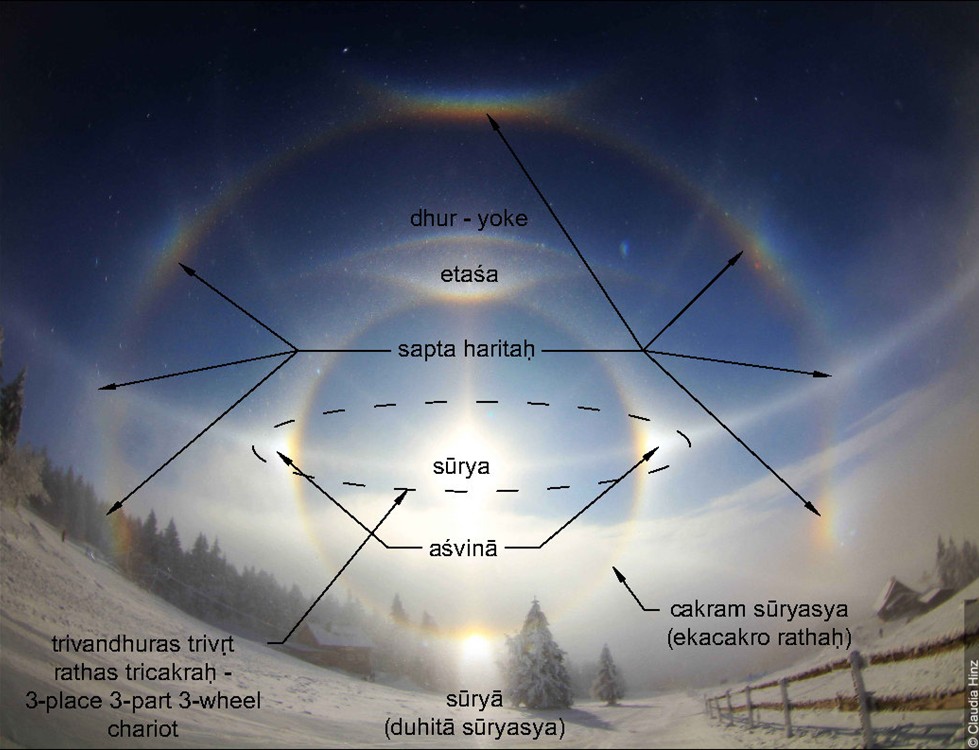
Fig. 3
The suggestions made above about associations inspired by the visual effects of halos and parhelia lead on to fresh interpretations of other obscure passages in the Rigveda. These may indirectly confirm the hypothesis advanced about the origin of stories connected with the Sun’s companions. For ease of comprehension, we have consolidated these interpretations in the list below.
Number - Verse - Sanskrit - Translation - Interpretation
1.
VII.63.2
etaśo vahati dhūrṣu yuktaḥ
wheel that Etaśa pulls, harnessed to the yoke poles[51]
The Parry arc, with its middle bulging upwards, may have evoked an association in the minds of the legends’ creators with a collar worn by the Sun’s horse.
2.
I.121.13
bharac cakram etaśaḥ
Etaśa drew not the wheel[52]
Describes a moment when the effects of the small halo or the large halo and the upper tangential arc of the small halo are not seen.
3.
V.29.5
sūryasya haritaḥ patantīḥ puraḥ satīr uparā etaśe kaḥ
when you put the flying golden mares of the Sun behind, though they were in front of Etaśa[53].
At sunrise, Etaśa (the upper tangential arc of the small halo) is located behind the horses of the Sun (the upper part of the large halo). At sunset, the direction of movement has changed and the horses appear to be behind Etaśa as the Sun heads downwards.
4.
V.31.11
sūraś cid ratham paritakmyāyām pūrvaṃ karad uparaṃ jūjuvāṃsam
The very chariot of the Sun, [which is] in front, at the decisive turning he will put behind, [though] it is speeding.[54]
In the evening, the Sun’s chariot (small halo) rushes ahead of Etaśa. In the morning (at the decisive moment) the chariot follows behind Etaśa.
5.
X.138.3
vi sūryo madhye amucad rathaṃ divo
The Sun unyoked his chariot in the midst of the sky[55]
When the Sun is higher than 32° above the horizon, neither the circumzenithal arc nor the upper lateral arcs of the large halo can form.[31]
6.
V.40.8,
sūryasya divi cakṣur ādhāt,
The eye of the Sun in heaven.[56]
X.10.9
sūryasya cakṣurmuhurun mimīyāt
Let the eye of the Sun repeatedly rise[57]
In combination with the small halo, the Sun looks like an eye.
7.
I.164.14
sūryasya cakṣū rajasaity āvṛtaṃ
The eye of the Sun moves through the haze[58]
The Sun and small halo are visible. The haze (small ice crystals suspended in the air) is the reason for the appearance of the halo effect.
8.
X.24.5
viśve devā akṛpanta samīcyor niṣpatantyoḥnāsatyāvabruvandevāḥ punar ā vahatāditi
When the united pair were rent asunder all the Gods complained. The Gods to the Nasatyas cried, “Bring these together once again.”[59]
The parhelia of the small halo have vanished due to the Sun rising higher above the horizon. The gods want them back. In this situation, the Sun is alone in the sky, without companions.
9.
V.59.5
sūryasya cakṣuḥ pra minanti vṛṣṭibhiḥ
They [Maruts] diminish the eye of the sun with their rains. [60]
At very high altitude or high latitudes, fleecy cirrus clouds produce rain that reaches the ground.[9] In wet weather, when the ice crystals in such clouds wholly or partially fall as rain, the halo effects are reduced or vanish altogether.
10.
I.163.10
īrmāntāsaḥ silikamadhyamāsaḥ saṃ śūraṇāso divyāso atyāḥ ।
haṃsā iva śreṇiśo yatante yad ākṣiṣur divyam ajmam aśvāḥThe heavenly horses, exerting their strength, the flanks [of the skein] have vanished, the middle is distinct. Like geese, the horse merge into a row, when they have completed their heavenly course.[61]
When at sunset the Sun drops lower than 15°, the infralateral arcs (“edges” of the halo) are already hidden below the horizon, while the supralateral arcs touch the large halo (coincide with it).
11.
I.6.2
yuñjanty asya kāmyā harī vipakṣasā rathe … nṛvāhasā
On both sides to the car they yoke the two bay coursers dear to him, bold tawny bearers of the Chief[62]
Describes a situation where the effects of the large halo and tangential arcs of the small halo are absent. Only the small halo and parhelia can be seen. At that moment, the Sun (along with Indra?) is being conveyed only by the Ashvins themselves, or their horses.
12.
V.55.3
sākaṃjātāḥ subhvaḥsākamukṣitāḥ śriyecid ā prataraṃvāvṛdhurnaraḥ
Strong, born together, they together have waxed great: the Heroes more and more have grown to majesty[63]
The Maruts are all the offspring of a single birth.
13.
V.52.10
āpathayo vipathayo 'ntaspathā anupathāḥ ।etebhir mahyaṃ nāmabhir yajñaṃ viṣṭāra ohate
“On the Path,” “Off the Path,” “Within the Path,” “Along the Path” - under these names the spreading band tend well the sacrifice for me.[64]
Four types of light cluster can be observed on the large Halo – the infralateral or supralateral arcs, the circumzenithal arc and the paranthelia.[31] The Sun does not move in a straight line, but in an arc, and so the direction of the various Maruts’ efforts relative to its course changes. Compared to the arcs of the small halo, those of the large halo are the most widely removed from the central luminary.
14.
VIII, 33.19
adhaḥpaśyasva moparisaṃtarām pādakau hara
mā te kaśaplakau dṛśan strī hi brahmā babhūvitha
Cast down thine eyes and look not up. More closely set thy feet. Let none See what thy garment veils, for thou hast become a Brahman lady.[65]
Sūryaa, the daughter of the Sun, wearing a dress (the lower tangential arch of the 22° halo) has boarded his ascending chariot (the small halo), an action that renders her holy. Despite her respect for her father, she needs to look not up at him, but down to intercept a possible indecent gaze at her from below.
15.
I.88.2
rukmo na citraḥ svadhitīvān pavyā rathasya jaṅghananta bhūma
With the ruddy, tawny horses they drive at will for beauty, with their horses that outstrip chariots—
provided with hatchets [the Marut flock] is sparkling like a brilliant. They keep pounding the earth with the wheel-rim of their chariot.[66]
The radiance of the large halo clusters (Maruts) resembles that of the Sun. The circle of the large halo always appears to be partially within the ground. The infralateral or supralateral arcs and the circumzenithal arc resemble hatchets.
16.
I.166.9
viśvāni bhadrā maruto ratheṣu vo mithaspṛdhyeva taviṣāṇy āhitā aṃseṣv ā vaḥ prapatheṣu khādayo 'kṣo vaś cakrā samayā vi vāvṛte
O Maruts, in your cars are all things that are good: great powers are set as ’twere in rivalry therein. Rings are upon your shoulders when ye journey forth. The axle of your wheels holds them firmly together.[67]
The Maruts carry the circle of the large halo (curved axle) on their shoulders, making use of up to five cars, rings or wheels (arcs of the large halo) that are the adornments of the Maruts.
17.
V.73.3
īrmānyad vapuṣe vapuś cakraṃ rathasya yemathuḥ pary anyā nāhuṣā yugā mahnā rajāṃsi dīyathaḥ
You [the Ashvins] – wondrous to behold –have set one wheel of the chariot aside. With the other through the realms you roam in might above the neighbouring tribes[68]
Through the efforts of the Ashvins the circle of the large halo has disappeared from sight. They journey across the sky on their wheel – the circle of the small halo – alone.
Taking this approach, we can briefly describe the optical effect of the halos and parahelia using the terms in the Rigveda. In the morning the Ashvins together with Etaśa and the Harit family of horses take the Sun into the sky. Once there, the Sun first unharnesses the Harits.[69] Later Etaśa disappears, taking with him the wheel of the Sun[70], after which it is conveyed solely by the Ashvins.[71] After some time, the Sun rises still higher, the Ashvins also leave the Sun, harnessing up his horse, or perhaps himself[72], leaving him to move across the sky alone the whole day. At the end of the day, all these actions take place in reverse order.
We should add that parhelia are most often observed at sunrise and sunset. At those times the sunlight is passing through the most low-lying clouds, in which the ice particles have become arranged in an orderly manner in the course of their fall, creating the conditions necessary for parhelia to appear. When those particles are distributed randomly, the parhelic effect is impossible. For the same reason, parhelia are a less frequent phenomenon than halos, since so close to the Earth’s surface it is far from always sufficiently cold (tens of degrees below freezing), while at a height of 5–10,000 metres there is always a strong frost. In higher clouds the particles (ice crystals) are usually distributed in a disorderly way, chaotically. As a result, instead of a certain number of clearly defined sundogs a great many parhelia appear out at different angles, merging into a circle around the light source. This produces a ring of light, usually only the small halo, the most prevalent phenomenon since the conditions for its observation arise most frequently.
Since cirrus clouds occur at high altitude in the tropics,[73] in that part of the world halos can only be observed in the mountains, while parhelia are not seen at all in low-latitude regions. If we proceed from the hypothesis that the stories in the Rigveda relating to the behaviour of the Sun and his companions in the firmament were prompted by an observer’s impressions of the effects of halos and parhelia, then it is possible to conclude that such an observer could not have been situated in the tropics, and must have been further north, in a moderate mid-latitude or cold high-latitude climate zone. In the middle latitudes the large halo effect is very rarely seen and even the small halo is not often visible. On the other hand, however, as Marcel Minnaert states:
“It is fairly certain that a practiced observer in our part of the world who is on the lookout all day long will be able to see on average one halo every four days, and in April and May he may even see one every two days; the most observant see halos on 200 days a year!”[74]
It would seem in our search for the “land of the gods” we should pay particular attention to parts of the world where the halos and parhelia are regularly and clearly visible, and that are, accordingly, located at high latitudes.
The Two Parts of the Nychthemeron
The lack of any mention of the day as part of the nychthemeron (full 24-hour cycle) in certain hymns of the Rigveda is valuable for research. They mention only night and dawn.
“From of old the two young girls of distinct forms, [ever] regenerating, [go] around heaven and earth along their own courses – Night with her black, Dawn with her gleaming white shapes progress one after the other.”[75]
“… seen alternate, those two blessed Goddesses, Morning [Uṣas] and Night who stir all living things to act.”[76]
“Night and Dawn, ever exchanging their colo[u]r, together suckle their single child. Between heaven and earth the bright ornament shines out.”[77]
“Night and Dawn, the undeceivable, will arrange it so that both day halves will keep guard over us.”[78]
Verse VI.9.1 refers to a bright ahar (ahar arjunam) and a dark ahar (ahaḥ kṛṣṇam), while in verse IV.55.3 quoted above Dawn and Night make up the two halves of the cycle, that is to say, implicitly the two ahars since grammatically the word ahanī, meaning the full 24 hours, is the dual form of the singular ahar. Probably the Dawn that is termed ahanā in verse I.123.4 is specifically the bright ahar (ahan) in the feminine gender. There is an alternative interpretation of ahanā as а-hanā, meaning “unkillable”. They may be homonyms.
The conception of the binary nature of the 24-hour cycle, made up of light and dark periods – dawn and night is confirmed by the way that, when describing the three offerings made by a Vedic Aryan, verse I.34.3, indicates the time of their performance to be evening and dawn. In other words, the Vedic dawn is a prolonged period, during which two offerings are made.
“Three times, Aśvins, make prize-giving refreshments swell for us, through the evenings and the dawns [during daylight].”[79]
When making his translation of the Rigveda, H.H. Wilson was probably struck by the illogicality of dividing the 24 hours into night and dawn alone, and so in his English version he used the word “day” instead of “dawn”.
On the basis of what is stated above, it is possible to hypothesize that when the hymns of the Rigveda were being written the period “day” (dina), the time between sunrise and sunset, was viewed by the Vedic poets as that part of the bright time (ahanā = uṣas) of the nychthemeron which is the period from the darkness of early morning to the darkness of evening, from the end of the night to its beginning. The division of the 24 hours into four periods (night, the half-light of dawn, day, the twilight of evening) is probably a later concept.
Continual Dawns
In the Rigveda great attention is paid to dawns, including Uṣas, the goddess of the dawn. The word “dawns” is repeatedly used with the epithet śaśvat – “permanent, constant, continuous”. Obviously dawns that take place every day can be termed constant. Why then is the Sun, which appears straight after the dawns with equal consistency, every day, not described as śaśvat? A particular dawn might even be called the most constant or most continuous (śaśvattama) as is the case in verse I.118.11:
“I invoke you, Aśvins, at the rising of the most constant [/continuous] dawn.”[80]
It is possible that śaśvat in this case has an emphasis not on constancy, but on continuity. Perhaps it is referring to dawns that are continuous in duration, more prolonged. However, dawn as the bright period of the nychthemeron lasts from morning till evening, that is to say, it is interrupted by the dark part of the cycle – night, just as the Sun is. Then, continuous dawns might perhaps be those uninterrupted by the darkness of night. In that case, the differentiation between dawns acquires meaning: ordinary dawns interrupted by the darkness of night and continuous dawns – twilights uninterrupted by the darkness of night. Such dawns can be witnessed in summer, during the “White Nights” period, in parts of the globe above 60°N. At such latitudes, the Sun is interrupted each day by the dawn, whether night fully falls or not. It is always discontinuous and so the continuity of the Sun is not accentuated in any way. Meanwhile the dawns, ordinarily interrupted by the darkness of night, become continuous during the White Nights due to the absence of complete darkness. In which case it makes sense to stress their episodically recurring continuity.
On the other hand, it is possible to suggest a different situation, when the dawn may or may not be interrupted by the Sun. In other words, besides the ordinary twilight interrupted in the middle by the Sun, there might also exist another type of dawn during which the Sun does not appear. That phenomenon is known as the polar night. Using the terms examined in the previous section, this is the same daily succession of dawn and night, only the dawns may not be interrupted by the Sun. In this context, the expression “most continuous dawn” acquires meaning. The most prolonged continuous dawn is that of the last few nychthemera of the polar night – the dawn preceding the reappearance of the Sun after its long absence. That is precisely why it is so significant, and why during that time the Aśvinā. charioteers of the Sun, are summoned, as indicated in verse I.118.11. Another interpretation of that hymn is bound up with the fact that beyond the Arctic Circle the dawn does appear with greater consistency than the Sun, and as a consequence the verse calls it the most permanent – śaśvattamāyā uṣas “always arriving”.
Immediately before and straight after the polar night, the Sun rises in the middle of the day. That is precisely what is reflected in verse V.69.3, which makes sense only if sunrise takes place at noon. “I call out at dawn to the goddess Aditi, at noon at the rising of the Sun…”[81]
It seems most likely that in the phrase tānīd ahāni bahulāny āsan yā prācīnam uditā sūryasya (VII.76.3). the reference is precisely to a certain number of nychthemera during the polar night. Griffith translates it as “Great is, in truth, the number of the Mornings which were aforetime at the Sun's uprising.” Wilson’s version is “Many are the days that have dawned before the rising of the sun.”
The polar night phenomenon can be observed at latitudes above 67.38°N.[82]
The Boundary of Night and Dawn
To continue with the analysis, we need to settle the question of determining the boundary between night and dawn, the dark and light periods of the nychthemeral cycle. Dawn, or more broadly twilight, in our modern understanding is the bright illumination of the horizon before the rising or after the setting of the Sun.
There are specific astronomical terms: civil twilight (when the Sun is between 0° and 6° below the horizon), during which the Sun is not visible, but it is still possible to distinguish the colours of objects; nautical twilight (when the Sun is between 6° and 12° below the horizon), when the brightness of the sky drops sharply and the first bright stars start to appear; and astronomical twilight (12° to 18° below the horizon), when the line of the horizon can barely be made out, the bands of light above it turn greenish, and the Milky Way appears in the sky. In present-day parlance, the term “dawn” mainly refers to the civil twilight.
We, however, are interested in which astronomical phenomenon a hypothetical observer above the Arctic Circle might have called “dawn”, where, to his mind, the boundary between night and dawn lay.
Let us examine three alternative definitions of “dawn” in the Vedic interpretation:
- “dawn” includes the bright part of the nychthemeron, civil twilight, nautical twilight and astronomical twilight, while “night” consists only of the period of complete darkness.
- “dawn” includes the bright part of the nychthemeron, civil twilight and nautical twilight, while “night” consists of astronomical twilight and the period of complete darkness.
- “dawn” includes the bright part of the nychthemeron and civil twilight, while “night” consists of nautical twilight, astronomical twilight and the period of complete darkness.
Considering the fact that the Rigveda describes a night lasting more than one nychthemeron, which will be addressed below, only the last alternative, with the night-dawn boundary at the juncture of civil and navigational twilights, remains of interest for further examination, since for the first two the sequence “last dawn – night lasting many nychthemera – first dawn” applies only at latitudes higher than the northernmost point of Eurasia.[83]
The Great Darkness
In the description of episodes connected with Indra we come across a certain period in which the days passed over or passed through the night.[84] It seems that this cannot be a reference to an ordinary night which one day “passes through”: several days do not “pass through” an ordinary night. It is possible to say such a thing only if the night was very long, lasting several nychthemera. Proceeding from the meaning of the word āhar(n), covered in the section “The Two Parts of the Nychthemeron”, the explanation which suggests itself is that at first there was a succession of dark and light parts of the 24-hour cycle, then a long night, followed once more by a succession of dark and light periods.
The word tamas – “darkness” – occurs in the Rigveda 109 times, 20 of those with some further characterization. Those epithets are “blind, impenetrable”[85], “all-encompassing, dominant”[86], “joyless”[87], “enclosed”[88], “dense, rolled up”[89], “opaque, turbid”[90], “sunless”[91], “black”[92], “dense, covered”[93], “lengthy darkness”[94], “great”[95], “extended”[96] and “unorderly”[97]. Among this list, the last four definitions are of particular interest, pointing to the difference between the darkness in the hymns and that of an ordinary night, the period of the nychthemeron without a dawn (as has already been shown, for the Vedics the period of “day” formed part of the longer period of “dawn”). The darkness is described not only as great, extended, exceeding in length the darkness of night, but also unorderly, not instituted by the gods. The Law (ṛta), ordinance or regulation (vratá) of the gods calls for the alternation of night and dawn throughout the year. That is precisely what is accentuated in the following verse:
“They who with laud extol the ancient statutes, when they shine forth infallible [day and night] dividers, have ordered as perpetual Law Organizers, and beamed as holy-thoughted Wonder-Workers.”[98]
It seems that the “great darkness” which breaches the law of alternating day and night resembles the night without replacement by days that occurs before the birth of the year in the cosmogonic hymn X.190 examined earlier.
Thus, in the opinion of the present authors, the epithets great, long, and extended, as well as irregular or unorderly, can apply only to the darkness in the middle of the polar night, the period between the last twilight at the start of the polar night and the first twilight at its end.
This phenomenon can be observed at latitudes above 72.55°N, where in the middle of the polar night a nychthemeron first occurs without the appearance of civil twilight at midday – a full 24 hours of complete darkness, total impenetrable gloom.
Division of the Dawn and Correspondences
We would point out that the hymns of the Rigveda do contain an indication of the division of the dawn into parts. The number of those parts is also significant. The poet stresses that there is not one dawn but several, and the goddess of dawn Uṣas is the first or last of them:
“The last of those who, one by one, have gone, the first of those who come hither — Uṣas has flashed forth.” [99]
“The last of those who, one by one, have gone, the first of those radiating forth – Uṣas has whitened widely.” [100]
Perhaps this is a reference to two periods of the nychthemeron – morning and evening twilight, while Uṣas, the least radiant dawn, is the last light of evening and the first light of morning.
If Uṣas is the goddess of the least radiant dawn, then the bright part of the nychthemeron begins and ends with her. She appears at the beginning and the end of both the brighter and the less bright parts of the 24 hours.
“Wakening the sleeping like a fly, she has come as the most constant of those who, one by one, have come here again [and again].”[101]
It might seem that there is no point in splitting the morning twilight into parts, but then why does the Rigveda repeatedly mention such a division?
“They have stood up – the bright Dawns – in the east, like the sacrificial posts fixed at ceremonies”. [102]
It does not matter whether the reference is to the brief dawn of tropical India or the longer period of bright sky before sunrise in the middle latitudes to the north, where, many researchers believe, the Aryans lived before their invasion of the subcontinent. In either case, the division of the morning twilight that itself goes on for substantially less than an hour into separate periods leads to each of those lasting a mere matter of minutes. Besides that, there is a lack of visual boundaries between them.
The idea of dividing the dawn into periods becomes more understandable if we imagine that the Vedic poet perceives the human days or nychthemera as resembling the “days or nychthemera of the gods”, i.e., the calendar year. Developing F.B.J. Kuiper’s hypothesis about the cyclical character of time in the Rigveda connected to the length of the year, it is possible to put forward the idea of correspondence[103], that is to say, parallels between the Vedic Aryans’ daily or nychthemeral cycle and the annual cycle in the distant lands of the Aryan gods and bards. Thus the division of the dawn into separate periods is probably associated in the poet’s mind with the multitude of twilights after sunset or before sunrise in the land of the gods. In the present authors’ opinion, there can be no other reason for splitting the half-hour dawn of southern latitudes into parts.
Some time after the composition of the Rigveda hymns, the proposition became established in Indian religious culture that “in the home of the gods day and night are equal (in length) to a year among people”.[104]The Rigveda states that victory over the forces of evil was an annual event.[105] Thinking along those lines, we shall seek confirmation of the idea that the Vedic Rishis considered their day to resemble the year-long day of the gods.
With regard to the dawns, the sacred text makes mention of a distance of 30 yojanas.
“Immaculate, [the dawns] cover thirty yojanas in one day; one after the other they realize the [divine] intention.[106]
Scholars reckon the length of a yojana to have been somewhere between 3.5 and 17 kilometres.[107] So 30 yojanas would be a distance of 105 to 510 kilometres. In reference to dawns, such a statement makes no sense.
Besides being a unit of distance, however, the word yojana has several other meanings, including “harnessing”,[108] in other words, some action that can be regarded as repetitive. Incidentally, the Chinese Records of the Western Regions[109] informs us that a yojana was the distance that the army of a wise ruler covered in a day. That is to say, it may mean not so much a specific figure as some daily act.
“The shining Dawns have arisen for splendour, glistening like the waves of the waters.”[110]
The poet’s dawns follow like waves on water, which might also be an indication of their periodic character. This bears out once again the idea of their cyclical appearance in the land of the gods. Moreover, we can suggest that for the poet the dawn that he sees is made up of several equal parts which he knows about from legends. Let us suppose that with his thirty “harnessings” the poet is allegorically describing thirty dawns occurring one after another in the land of the gods.
Following on from the above, we can hypothesize that the land of the gods is located beyond the Arctic Circle, in latitudes with a polar night of some duration – perhaps 30 nychthemera or more.
Uṣas is associated with another goddess, Dakṣiṇā, whose name can be translated as, among other things, “the Southern one”:
“She [Uṣas] makes all pathways, all passages easy to travel. She has appeared – the good Dakṣiṇā, the bounteous one.”[111]
However, the dawn in middle and southern latitudes does not begin in the south, in contrast to the dawn of the mid-polar night. If some hymns speak of Uṣas as the weakest dawn, then she ought to be the most southerly even among the rest of the dawns of the polar night, which cover a greater expanse of space above the horizon. In the Rigveda, the dawns rise in the East, which is logical considering the consensus of opinions among researchers regarding the territories settled by the ancestors of the Indo-Europeans.[112] It seems that the epithet “southern” given to the goddess Uṣas may confirm a location beyond the Arctic Circle for the observers of the astronomical phenomena that formed the foundation for the legends passed down to the Vedic poets, and the by-name Dakṣiṇā applies to Uṣas, the dawn of the middle of the polar night, or the weakest manifestation of civil twilight in the northern land of the gods.
The weakest dawn takes the form of a reddish band at the edge of the sky.
“The purple-tinted Uṣas has appeared, following the truth she has made the light.”[113]
In the present authors’ opinion, the parts of the Rigveda devoted to the dawns may be connected with locations in the Arctic.
The Northern Dragon and Waters
In the Middle Ages, the Chinese believed that the aurora borealis was a dragon beyond the Great Wall of China with a candle burning in its mouth.[114] A dragon was probably also a reflection of the northern lights in the minds of the people who produced the pre-Rigveda legends, Nowadays, the average values for the lines of magnetic latitude that form the northern and southern boundaries of the auroral oval, where the phenomenon most often occurs, are 70°N and 62°N.[115] When there is no strong solar activity, the boundary takes the form of a long green-coloured strip at a height of some 90–120 kilometres above the surface of the Earth. The northern, polar boundary of the oval is better defined and brighter than the southern, equatorial one. When the intensity of the solar wind increases, the line of the oval bends and eventually breaks. The glow extends upwards, adding yellow and shades of red.[116] In L.M. Alekseyeva’s view, the auroral oval of the northern lights resembles a serpent, while the substorms that sometimes disrupt the aurora might well be interpreted as a battle.[117] It would seem that the equatorial boundary of the auroral oval is less serpent-like, and so we shall focus on the latitudes closer to the polar boundary. Considering the significant height of the northern lights (around 100 km above the surface), we shall try to establish the approximate width of the belt within which they can be seen. At 9° remove from the oval it will merge completely with the line of the horizon, so the limits for observation can be estimated at 5° (or 555 km) either side of the most probably latitude for the polar boundary of the auroral oval (70°N). The provisional nature of the calculations, as well as the gradual shifting of the Earth’s magnetic pole, makes it impossible to precisely establish the latitudes at which the polar boundary of the aurora could have been observed in ancient times. If we consider the belt between 65°N and 75°N, then we can identify a number of archaeological cultures that existed in those parts of the Far North of Eurasia in the 3rd and early 2nd millennia BC.
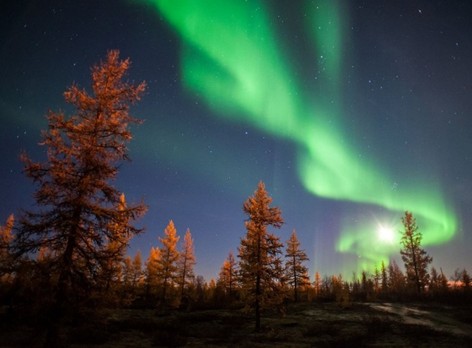
Fig.4
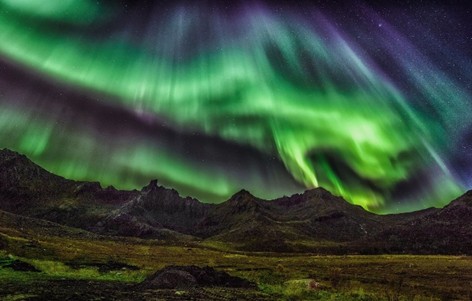
Fig.5
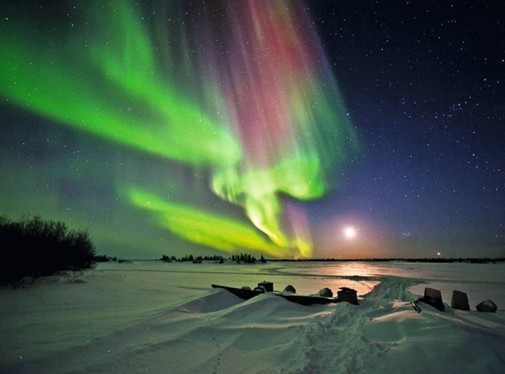
Fig.6
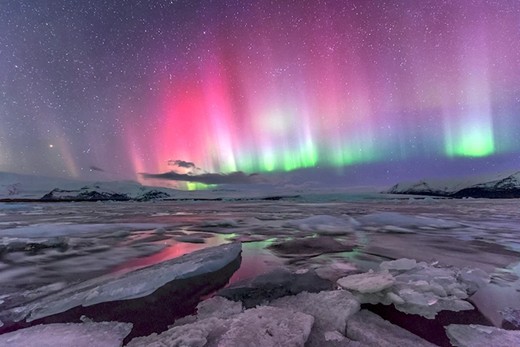
Fig.7
The territories of the Far North are places where water lies on the ground in the form of ice and snow in winter, while in the air, including above the horizon, a frosty haze hangs, made of moisture in the form of ice crystals. An observer might take the setting of the Sun on the day of the start of the polar night and the reappearance of the Sun at its end as first the Sun’s departure behind the horizon, into the waters, where it transforms into an embryo, and then the birth of the Sun from out of the water[118] in the state of “snow and ice” and/or a “haze”. In contrast to the Far North of Europe, today there are no ground waters in the Asiatic Arctic, since the land there is frozen to a depth of many metres.[119] The consequence is a huge number of streams and rivers (“many thousand”)[120] in the warm part of the year.
So, there is a part of the world with a polar night, the prolonged absence of the Sun in the sky and the periodic appearance of dawns on the horizon. The poet was aware that in the home of the gods before the rising of the Sun and after its setting, not one single dawn would appear in the sky, but a whole series of dawns, and that is why he perceived the usual morning dawn in the world of people as being composed of parts. A dawn of the polar night occurring just once, on the day of the winter solstice, is observed at a latitude of 67.38°N. The territory north of 67.4°N is a place that has several (more than four) nychthemera of polar night with dawns at noon.[121] The 67.4°N line of latitude extends across the whole of Eurasia, from Scandinavia to Chukotka.
The Territory with Thirty Dawns
Verse I.123.8 states that the dawn has thirty yojanas or “harnessings”. If the gods have 30 dawns in their, divine, day, that is the 30 nychthemera of noontime twilights without the Sun during the calendar year in the North (the land of the gods), i.e., a 30-day-long polar night.
The precise latitude at which the polar night lasts 30 nychthemera is 68.25N. Its line runs through the Scandinavian, Kola and Yugor Peninsulas in Europe and on across the northern part of Asia from the Urals to Chukotka. This location falls within the territory specified in the previous paragraph.[122]
If in their morning the gods have not one dawn, but 30, and the gods’ day resembles the mortals’ year, then that could be a reflection of a situation where people’s morning twilights are being correlated with the 30 nychthemera of twilights at the end of the polar night, while the 30 evening twilights are associated with the 30 nychthemera of twilights at the start of the polar night. That is to say, there should be either 59 (29+ Uṣas+29) or 60 dawns. This accords with the situation on the North Siberian Lowland and the Yana-Indigirka Lowland, or in the adjoining uplands. In that location, diminishing twilights with the final dawn Uṣas immediately give way to growing twilights of which Uṣas is the first. If Uṣas is the last of 30 dawns and also the first of the following 30, then the location has a polar night of 59 nychthemera. At latitudes above 70.67°N, the polar night (and thus twilights without the appearance of the Sun) lasts more than 59 nychthemera. If the story-teller’s description of the place where cosmic law was established was not exact and based only on the factor of a polar night (the period when there is twilight at noon but no Sun) that lasted at least two months, then we need to turn our attention to the territories north of the given latitude.
Let us look at a location with a latitude of 72.55°N on the North Siberian Lowland. The polar night at that latitude lasts 74 nychthemera,[123] among which in the middle of the polar night there are entire 24-hour periods without any dawn, without civil twilight appearing roughly at noon. Just 33 kilometres north of that spot, at 72.85°N, the polar night lasts 78 nychthemera and 30 dawns can be observed at both its beginning and end.[124] The remaining 18 nychthemera are the darkest, with no more than navigational twilight at noon, when the brightest stars are still visible in the sky, while the colours and shapes of objects are indistinct. If the word “dawn” is taken to mean full daylight plus civil twilights, then at this latitude there are 30 dawns at the start of the polar night and 30 at the end.
The Name of the Dawn
Moving northwards from 72.85°N, we find ourselves in latitudes where the periods of twilights at the start and end of the polar night get increasingly shorter, while the period of complete darkness expands. At 75°N that darkness (“night of the gods”) reaches a length of 50 nychthemera, while the periods of the polar night before and after it are each 21 nychthemera long.[125]In the middle of any 24 hours during those two periods one can see twilight without the Sun. In the Rigveda, Uṣas, the goddess of the dawn, is called the mother of cattle.[126] At the same time it is also stated that Uṣas has various names.
“To house after house she [Uṣas] drives in her greatness, day after day assuming [new] names.”[127]
Here is what the men (Uśíjo IV.1.15) are said to have done at the end of the turbid darkness (IV.1.17):
“They brought to mind the first name of the milk-cow; thrice seven [21] highest [names] of the mother they found. [The cows] recognizing it [=the name], bellowed out [to the men], [like] maidens [announcing their bridegroom choice]. The ruddy one [=Dawn] became manifest with the glorious [name] of the cow.” [128]
The association is not particularly clear, but perhaps in this hymn the uśíjo gave each dawn after the prolonged darkness a separate name, and the verse applies to a territory where at the start and end of the polar night civil twilights (dawns) appear for 21 nychthemera in succession, which indicates the 75°N line of latitude that crosses the northern part of the Taymyr Peninsula.
When at the northernmost point of the North Siberian Lowland, at 75°N, the great turbid darkness is coming to an end, in its southernmost part, at 70°N, the Sun is already showing itself, as might be attested by the following verse of the same hymn.
“The Sun mounted the lofty [/wide] fields [/expanses], beholding deeds of men both good and evil.” [129]
The Moon
An observer above the Arctic Circle would inevitably notice the Moon in the sky. In frosty weather it too is accompanied by a halo and by parselenes (or paraselenes – “mock moons”) out to the sides. The higher the latitude, the greater the number of nychthemera when the Moon is hidden below the horizon. To the south of the Arctic Circle that does not occur. The Rigveda includes a personage named Rebha, who was extracted from the waters by the Aśvinā. This is how his ordeal and its end is described:
“Within the waters through ten nights and nine days, bound and pierced by the malicious one, Rebha, who bobbed and twisted in the water – him you two [Aśvinā] brought up, like soma with a ladle.” [130]
The main part of the North Siberian Lowland extends from 75°N down to 71°N.[131] At those latitudes, the Moon is hidden below the horizon (in the water) for roughly 9 or 10 days each month.
It would seem that in the Rigveda Rebha might have been associated with the Moon, and the Aśvinā with parselenes as well as parhelia.
The Sea
Coming back to the passages in the Rigveda that include geographically detailed descriptions, let us turn to the episode about Vāta’s horse that lives in the expanses of the western and eastern seas (X.136.5). Both the Yugor and Taymyr Peninsulas and the Yana-Indigirka Lowland are places where there are two large bodies of water to the East and West that can be perceived as the eastern and western seas. For the Yugor Peninsula those would be the Barents and Kara Seas, for the Taymyr Peninsula the Kara and Laptev Seas, for the Yana-Indigirka Lowland the Laptev and East Siberian Seas.
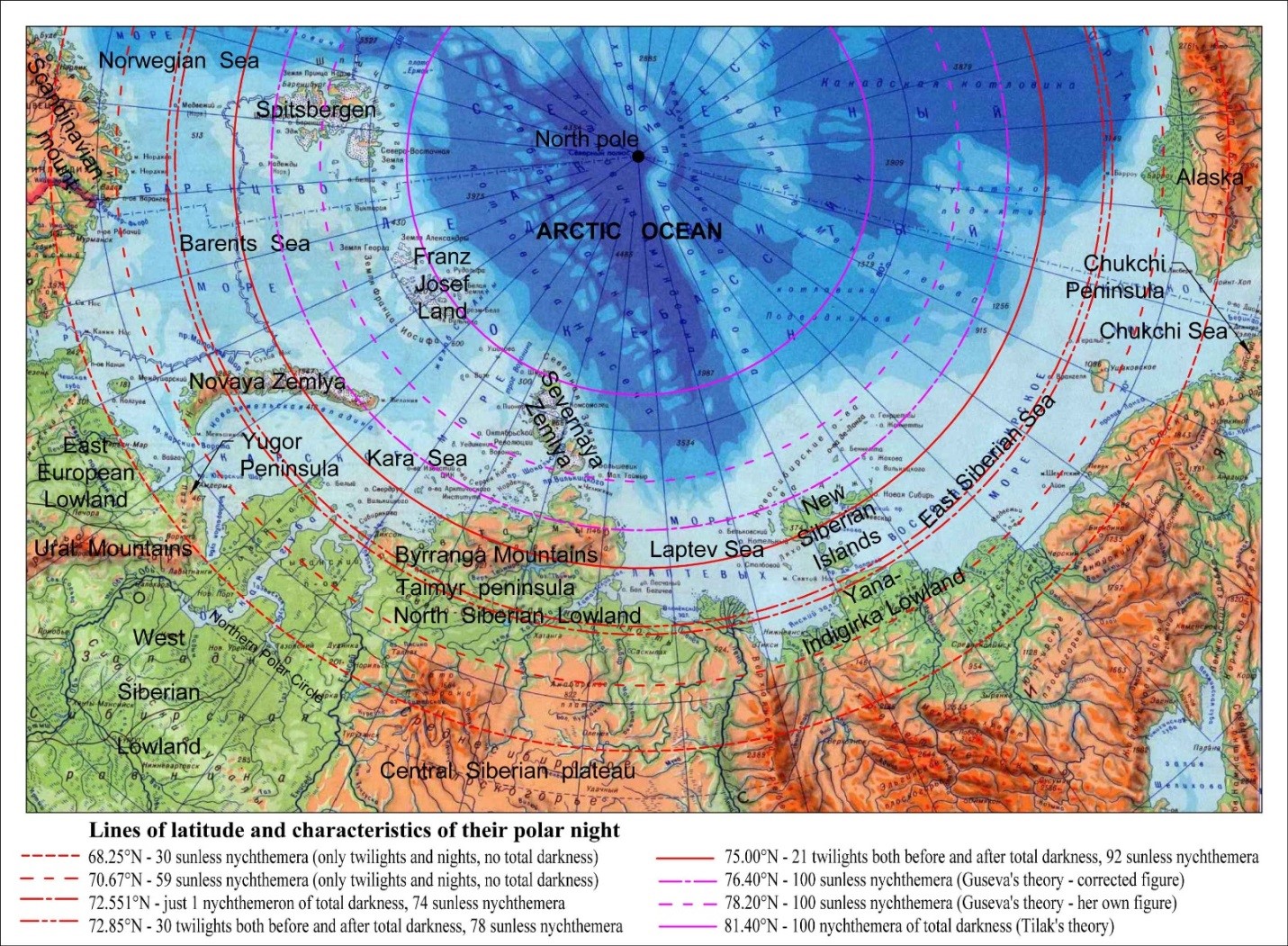
Fig. 8
It seems sensible to exclude the North of the Scandinavian Peninsula from our search due to the absence of a clear visible divide between the Norwegian and Barents Seas, as well as its location to the south of 71°N. We should also set aside the Barents–Kara Sea pairing since the Yugor Peninsula that lies between them is wholly south of 70°N. Both those peninsulas are thus situated below 72.55°N, the latitude northwards of which there is a period of “great, long and unorderly darkness” in late December. That leaves only the Taymyr Peninsula, and the Yana-Indigirka Lowland, which is highly unlikely as there are less than 30 kilometres there between 72.55°N and the shore of the Arctic Ocean.
Summing up all that has been stated above, it is possible to arrive at the following deductions:
- Dawn and night, for the authors of the Rigveda, are two parts of the 24-hour cycle (nychthemeron); the former may, or may not, include a period when the Sun is in the sky (full daylight).
- The alternation of dawn (with or without full daylight) and night is instituted by regulation (vrata); the Vedics perceived the darkness of an ordinary night following the days as a pattern instituted by the gods, orderly and proper.
- The boundary between dawn and night in the Rigveda most probably corresponds roughly to that between civil and nautical twilights.
- The annual cycle described in the Rigveda presumes the lengthy absence of the Sun during the polar night.
- The great, boundless, extended, unorderly or un-instituted darkness is a description of that period in the middle of the polar night when there are a certain number of nychthemera without twilight at noon, which occurs at latitudes roughly above 72.55°N.
- The great darkness is probably also the “cosmogonic night” (Х.190.1) that manifests itself before its division by dawns into the light and dark parts of the 24-hour cycle.
- The start of the year, as the creators of the Rigveda see things, may also be connected with the start of the alternation of light and dark parts of the 24-hour cycle (Х.190.2), while sunlight (Х.190.3) appears later.
- Part of the land of the gods and bards was most probably located further south than the territory of the “great unorderly darkness”.
Proceeding to an analysis of the theses listed above, it is possible to suggest that the most probable location for the “land of the gods, Indra’s great deeds and the bardic Angirases” would be the territory of the Taymyr Peninsula and adjoining areas between 68.25°N and the shore of the Arctic Ocean.
Analysis of Existing Archaeological Facts and Hypotheses
1. Archaeology and Climate
If the origins of the Rigveda’s narrative legends are connected to people’s real-life impressions, then human habitation in the pre-Rigveda period in or near the locality being considered as the cradle should be confirmed by modern-day archaeological finds. The area roughly between 71°N and 73°N was explored by the archaeologist Leonid Khlobystin half a century ago.[132] There are Neolithic sites with Corded Ware pottery of the Bel’kachi culture type dating from the third millennium BC, the period before the creation of the Rigveda, at those latitudes on the Taymyr Peninsula. The territory above 73°N has not been properly explored.
It should be noted that earlier than the third millennium BC ancient humans lived even above 75°N. A settlement that existed on Zhokhov Island, one of the New Siberian Islands, located at 76°N, during the Holocene Climate Optimum has been approximately assigned to the start of the 6th millennium BC.[133] We know, however, that the first hymns of the Rigveda date from at least four millennia later (the 2nd millennium BC).[134] Four thousand years is around 150–200 human generations. Even if the dating of the Rigveda were imprecise, the preservation of narrative legends through a chain of a hundred-plus storyteller-listener links would seem incredible. The most northerly site that has been found from the 3rd millennium BC is Khatanga II (or Kuchugui-Yurakh I) situated 330 kilometres to the south of the 75th parallel (70°N, with a 70-nychthemeron polar night).[135]
Judging by Dmitry Bolshiyanov’s research,[136] annual average air temperatures on the Taymyr Peninsula dropped significantly over the 3rd millennium BC, and with the onset of the Subborial period in the middle of that millennium the climatic situation grew considerably worse, which may have led to southward migrations by the Taymyrians.
2. The Likelihood of Cultural Expansion
When considering potential locations, specialists often restrict the home of the gods, of Indra’s deed and the Angirases to proven places of habitation of the ancestors of the Indo-Europeans. Yet history has repeatedly demonstrated cultural expansion between peoples belonging to different linguistic groups.
The history of the spread of Christianity, for example, is evidence of the potential for a small group of the religion’s founders (representatives of the Semitic language subfamily) to influence the Indo-European social and linguistic environment. The birthplace of Christianity was the Roman province of Judea, its chief protagonists were Hebrews. However, all the main religious texts were written in the Ancient Greek language, from which translations were then made into Latin, Church Slavonic and other languages. Since all of this took place in a period with a developed writing tradition, the line of culturological continuity is clear and arouses no doubts. If Christianity was like Hinduism, though, and lacked a written record at the beginning of its development, then the Christian tradition, having spread in Europe, might have lost the link between its teaching and its place of origin – Palestine. This in turn might have given rise to a theory that Palestine was located in Greece on the grounds that the Gospels were written in Greek.
It is entirely possible in our case that a sizeable, or not so sizeable, portion of the ancient Taymyrians could have ended up among the ancestors of the Indo-Europeans, passing on their stories or legends, and also shaping the beginnings of a new cultural tradition.
3. The Arctic Theory
Attempts to find a place of origin beyond the Arctic Circle for the legends recounted in poetic form in the Rigveda go back over a hundred years. It has been one of the possible alternatives considered by researchers as the abode of the people whose tales served as the basis for the most ancient Aryan legends. Copious errors in the works of those who favoured the Arctic theory about the origin of the myths and legends behind the Rigveda led to the overwhelming majority of scholars coming to describe this line of study as pseudoscientific.
Bal Gangadhar Tilak, the pioneer of the Arctic theory, postulated the existence of a proto-Eurasian civilization on a continent around the North Pole in the interglacial period.[137] He suggested that the Aryans had once lived at latitudes with a polar night that persisted for a period of 159–160 days. His hypothesis was founded upon an interpretation of the thirty dawns as a 30-nychthemeron period at the start or end of the polar night,[138] and the serpent Vṛtra’s 99–100 autumnal[139] forts or ramparts[140] or perhaps rings[141] as 99 or 100 nychthemera of total darkness between dawns.[142] Subsequently the hypothesis about an interglacial Aryan homeland around the North Pole failed to find any confirmation with regard to either time or space. A 100-nychthemeron period of complete darkness is in fact accompanied by two periods of not 30, but 15 noontime twilights each, which corresponds to 81.4°N.[143]
Natalia Guseva, a Russian researcher on the topic of the Artic theory, corrected Tilak’s prediction of the maximum length of the polar night in the location of the most ancient foundation for the myths and legends, suggesting a version in which the 30 dawns at the start of the polar night and 30 dawns at its end are included in the figure of 99–100. Therefore, in Guseva’s view, the northern boundary of the territory inhabited by the Aryans, ought to have had 99–100 sunless nychthemera. However, in her study the researcher made an error when converting the length of that polar night into a specific value for latitude (Guseva gives 78.2°N).[144]
DURATION IN NYCHTHEMERA (24-HOUR PERIODS) OF THE POLAR NIGHT AT GIVEN LATITUDES
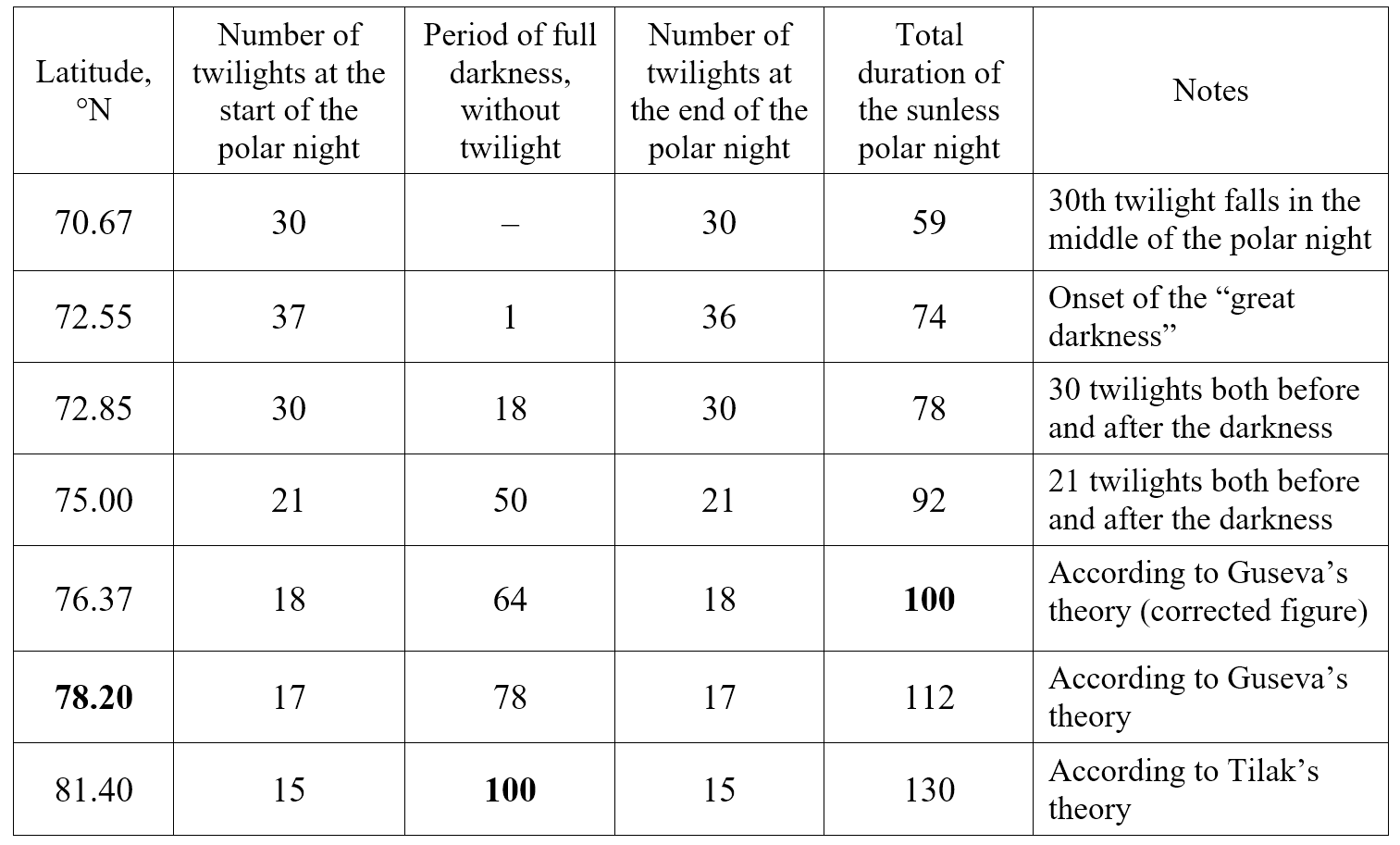
Tilak’s lack of correct data about the northern lands and ancient climatic conditions and Guseva’s somewhat overhasty conclusion preсlude the use of their opinions as a basis for further research. There are no grounds for believing that speakers of any Indo-European language lived above the Arctic Circle. Nor have any substantially sized territories been found in the basin of the Arctic Ocean that could be the location of the geographical objects described in the Rigveda. Even if Guseva’s error is corrected, a 100-ntychthemeron polar night brings us to the latitude 76.4°N, where we find not 30 twilights at the beginning and end of the polar night, but just 18. In any case, that latitude cannot be linked to a single hitherto discovered archaeological culture close in time to the period when the first hymns of the Rigveda were composed.
However, at higher latitudes than the places settled by the Proto-Indo-Europeans,[145] at a time spanning the period when the Rigveda’s first hymns were created, there were peoples living in the Far North who were the ancestors of speakers of the Uralic group of languages (Proto-Uralians). It is logical to assume that they also had certain cultural traditions. The absence of significant artefacts of material culture cannot be taken as an indication of a lack of oral creativity.
Grigory Bongard-Levin and Edvin Grantovsky suggested that the legends of peoples living in the Arctic zone might have been passed on to the Indo-European milieu that acted as the foundation for the Ancient Indian, Ancient Iranian and Greco-Roman traditions.[146] Those authors point to the similarities between rites among the Indo-Iranians and shamanic practices among Uralic peoples, both using ecstatic beverages producing similar effects. They develop upon R. Gordon Wasson’s theory[147] that the basis for such drinks (the Indo-Aryans’ soma, the Iranians’ haoma) may in some ancient time period have been the fly-agaric mushroom used by shamans.[148] The two scholars also note Bernát Munkácsi idea[149] about the resemblance of the Śarabha, a many-legged beast in Indian legends, to the magical six-legged elk of Ugrian legends and the heavenly elk in the folklore of the peoples of Siberia.[150] The historians describe the similarity in details between the account of the Persian king Darius I coming to power and the Mansi legend of the accession of Mir-Susne-Hum, a son of the supreme god, to the throne of Earth,[151] as well as the similarity of the flights of the Indian Nārada and the Greek Aristeas to the aerial voyages of Siberian shamans. They also advance an interesting hypothesis about the linguistic link between the Sanskrit word rip (in III.5.5, ripó ágram translates as “the summit of the Earth”), the Riphean Mountains that Greco-Roman geography located in the remote north, and the Khanty word rêp,[152] meaning “mountain”.[153]
The study of the existence of borrowings between the Proto-Uralic and Proto-Indo-Iranian languages does have a history. Following the publication of Károly Rédei’s etymological dictionary of Uralic[154] and Gyula Décsy’s reconstruction of the Uralic protolanguage,[155] it became possible to work with data not from individual Finno-Ugric and Samoyedic languages but from their common ancestor – the Uralic protolanguage. Contacts between the Proto-Uralic and Proto-Indo-Iranian tribes and their languages took place over a long period of time.
There are grounds for asserting that a number of Proto-Uralic words were adopted into the Proto-Aryan language, and those borrowings have their own semantic characteristics – they belong mainly to the realms of flora and fauna, or else are names of parts and organs of human and animal bodies. Within the dictionary section of Décsy’s book, an Indologist will be struck primarily by the Proto-Uralic words that display a great similarity to Sanskrit ones in both form and meaning. Meanwhile the etymology of the words in question cannot be traced within Sanskrit (or indeed Indo-European material in general).[156]
Deductions
The following is a list of the mysteries of the Indian epos that find explanations if the land of the gods was located on the Taymyr Peninsula and adjoining areas.
- The division of the morning and evening twilights into parts in the Rigveda poets’ place of habitation can be connected by correspondence with the analogous number of nychthemera of the polar night with noontime twilights. Localization – above latitude 67.4°N.
- 30 “harnessings” of the dawn can be connected with the 30 nychthemera of a polar night. Localization – latitude 68.25°N.
- 30 “harnessings” of the dawn in the morning of the gods’ day and 30 more in the evening can be correlated with the situation in a place with a two-month polar night. Localization – roughly latitude 70.67°N.
- 30 “harnessings” of the dawn in the morning of the gods’ day and 30 more in the evening, as well as a period of impenetrable (great) darkness between them can be connected with a location roughly at latitude 72.85°N, where the month at the start and the month at the end of the polar night are periods with civil twilights at noontime, while the interval between those two months was a 17-nychthemeron period of continuous nights with only navigational twilights at noontime, which was perceived as the time of the great darkness.
- The 21 names of the mother of cows, Uṣas the dawn, after the “unorderly” darkness might represent the 21 days with twilight at noon but still no Sun at the end of the polar night in locations roughly at latitude 75°N.
- Such geographical objects as a great plain and mountains, as well as at least seven mighty rivers, mentioned in the Rigveda, can be found in the area of the North Siberian Lowland and its surrounding mountains.
- The western and eastern seas (oceans) next to which the serpent Vṛtra and Vāta’s horse live correspond to the Kara and Laptev Seas.
- The birth of the Sun in water might be associatively connected with the re-appearance of the Sun after the long polar night from beneath the snow- and ice-covered ground, in a frosty haze. The thousands of streams of water in the warm part of the year might be an indication of the permafrost zone.
- The heavenly serpent Vṛtra might be a reflection in people’s minds of the polar boundary of the auroral oval of the northern lights, while a substorm disturbing the radiant display is interpreted as a battle.
- The small solar halo might have found reflection in legends as the wheel of the Sun, the chariot of the Sun or the outer part of the eye of the Sun.
- Identical mock suns or moons either side of the main luminary (Sun or Moon) might have been the source for legends about the Ashvins twin charioteers; the parhelia might also be associated with the two horses drawing the chariot of the Sun or Indra.
- The clusters of light on the small halo above the solar disc might evoke an association with Etaśa, the Sun’s bull, and his yoke.
- The reflection of sunlight off the snowy ground when the Sun is lower than 22° above the horizon and the lowest point of the solar halo when it is higher might have led to the appearance of the legend about the Sun’s daughter who boards his chariot driven by the Ashvins.
- The seven Harits, horses of the Sun, and the divine Maruts are probably connected with the seven clusters of light on the large halo around the solar disc.
- The Moon disappearing belong the horizon for nine or more nychthemera may have acted as the source for the legend of Rebha, bound and thrown into water for 10 nights and 9 days. Localization – roughly latitudes 71–75°N.
- The phrase adhi saṃvatsaro ajāyata in the cosmogonic hymn (Х.190.2) should probably be translated not as “the year was born”, but as “the year was reborn”. Consequently, that rule ought also to be applied in the analysis of other phenomena described in that hymn.
Conclusion
On the basis of the echoes of actual geographical features that are described in the Rigveda, it is possible to suggest that India was only the location for the final completion of the Rigveda, a tremendous poetic work based on the legends of people who inhabited the Far North of Eurasia in ancient times. In that respect, the existing theory of the Rigveda having come into being on the territory of Punjab does not clash with the conclusions of the present study. The text of the Rigveda cannot be simply a translation of hymns from some northern language, since the work makes such specific use of the distinctive linguistic characteristics of Sanskrit, in particular the category of grammatic gender that does not exist in Uralic languages, as well as all manner of epithets with multiple meanings for the personages.
At the same time, the identification of a new semantic context makes it possible to bring clarity to many obscure passages in the text of the Rigveda, and to avoid certain assumptions in translation that distort the original meaning.
In a further work the authors propose to produce commentaries on such passages, correct inaccuracies in existing translations that are compelled to infringe the grammatical norms of Sanskrit due to the hitherto prevailing lack of understanding of the work’s context, and also seek correspondences between the landscapes described in the Indian epos and actual geographical features in the Far North.
In our opinion, the further study of the characteristics of the territory described in the ancient Indian epos as the land of the gods should pay attention first and foremost to the North Siberian Lowland and its adjoining uplands.
Referenses
1. Alekseyeva L. M. Polyarnyye siyaniya v mifologii Slavyan: tema zmeya i zmeyebortsa. Полярные сияния в мифологии Славян: тема змея и змееборца (Polar lights in the mythology of the Slavs: the theme of the serpent and the serpent fighter), Moscow, Raduga. 2001.
2. Apte, V. S. The practical Sanskrit-English dictionary. Poona, Prasad Prakashan, 1957-1959. 3v.
3. Bhaṭṭācārya, J. V. A comprehensive Sanskrit-English lexicon: chiefly based on Professor Horace Hayman Wilson's Sanskrit-English Dictionary and compiled from various recent authorities for the use of schools and colleges. Calcutta, Calcutta Press. 1900.
4. Bolshiyanov D.Yu., Verkulich S.R.. Paleoklimat polyarnykh oblastey Zemli v golotsene Палеоклимат полярных областей Земли в голоцене (Paleoclimate of the polar regions of the Earth in the Holocene). St. Petersburg, AAII. 2018. pp. 42, 181.
5. Bongard-Levin G.M., Grantovskiy E.A. Ot Skifii do Indii. Zagadki istorii drevnikh ariyev. От Скифии до Индии. Загадки истории древних ариев. (From Scythia to India. Mysteries of the history of the ancient Aryans). Moscow, Mysl'. 1974.
6. Borovikov A. M. et al. Fizika oblakov Физика облаков (Physics of clouds) / A. Kh. Khrgian. - Leningrad. GIMIZ, 1961.
7. Butman L. S. The revision and clarification of the use words denoting the terms: ‘Moon’, ‘Month’, ‘Sun’, ‘Earth’ and the Verb ‘To be born’ in Vedic Sanskrit. International Journal of Sanskrit Research ISSN: 2394-7519 V.11, I.2, 2025. pp. 18-27.
8. Cappeller, C. A Sanskrit-English dictionary: based upon the St. Petersburg lexicons. Strassburg, Trübner. 1891.
9. Cloud types. [Electronic resource:] https://habr.com/en/articles/374459/
10. Decsy С. The Uralic Protolanguage: A Comprehensive Reconstruction. Bloomington, 1990.
11. Dostovalov B. N., Kudryavtsev V. A. Obshcheye merzlotovedeniye Общее мерзлотоведение. (General permafrost science). Moscow Univ. Press.1967. p. 85.
12. Edgerton, F. (1953). Buddhist hybrid sanskrit grammar and dictionary 2. 2. New Haven, Yale Univ. Press.
13. Elizarenkova T. Ya. Rigveda Ригведа [In 3 volumes] Moscow. Nauka, 1989-1999.
14. Gonda J. Vedic Literature. P. 209-210.
15. Griffith, Ralph T. H. The Rig Veda Benares, E. J. Lasarus, 1889.
16. Guseva N. R. Russkiy Sever – prarodina indoslavov Русский Север – прародина индославов (Russian North – ancestral home of the Indo-Slavs). Moscow. Veche. 2010. |Chapter Temneye vsego pered rassvetom p. 119.
17. Iyer, Paramasiva T. The Riks or Primeval gleams of light and life. Bangalore, Mysore Government Press. 1911. VIII+198 p.
18. Jamison S. W., Brereton J P., The Rigveda. The earliest religious Poetry of India. 3-v., Oxford University Press (ISBN 978-0-19-937018-4). 2004.
19. Kalla L. D. Home Of The Aryas With Notes. Delhi Univ. Press. #2, 1930.
20. Keith A. B. A History of Sanskrit Literature. Oxford. 1920. p. 67.
21 Khlobystin L.P. Ancient history of the Taimyr and the formation of the north Eurasia cultures. St. Petersburg. Dmitry Bulanin. 1998. p.63.
22. Kuiper, F. B. J. Ancient Indian cosmogony. Essays selected and introduced by John Irwin. Delhi 1983.
23. Manco, J. Ancestral Journeys. The Peopling of Europe from the First Venturers to the Vikings.
ISBN: 9780500292075 Thames&Hudson. 2015.
24. Minnaert, M. G. J. (Marcel Gilles Jozef) Light and Color in the Outdoors (New York: Springer-Verlag, 1993), p. 208.
25. Monier-Williams, M. A Sanskrit-English dictionary: Etymologically and philologically arranged with special reference to Cognate indo-european languages. Oxford, The Clarendon Press. 1899.
26. Moonrise and moonset times. [Electronic resource:] https://www.timeanddate.com/moon/
27. Muller, F. M., Anthropological Religion: The Gifford Lectures Delivered Before the University of Glasgow in 1891. Longmans Green. 1903. pp. 395—398.
28. Muller, F. M., The Laws of Manu. ISBN: 9780700715398 Taylor&Francis. 2001.
29. Munkácsi B. Árja és kaukázusi elemek a finn-magyar nyelvekben I., Budapest, 1901.
30. Oldenberg H. Das altindische Akhyana. ZDMG. BD. 37. 1883.
31. Optical phenomena of the atmosphere. [Electronic resource:] https://www.ursa.fi/ilmakeha/havaitseminen/havaintoja/european-halo-project/ehp-1997/appendix.html
32. Pitulko V.V., Hartanovich V.I., Timoshin V.B., Chasnyk V.G., Pavlova E.Yu., Kasparov A.K. Drevneyshiye antropologicheskiye nakhodki vysokoshirotnoy Arktiki. Zhokhovskaya stoyanka, Novosibirskiye ostrova Древнейшие антропологические находки высокоширотной Арктики. Жоховская стоянка, Новосибирские острова. (The oldest anthropological finds of the high-latitude Arctic. Zhokhov island site, New Siberian Islands). Ural Historical Bulletin No. 2 (47). 2015 p.61.
33. Polar lights in Russia. [Electronic resource:] http://activehike.ru/severnoe_siyanie/
34. Redei K. Uralisches Etymologisches Worterbuch. Budapest, 1986— 1988. P. 1 — 7.
35. Satapatha Brahmana https://sacred-texts.com/hin/sbr/sbe12/sbe1228.htm
36. Semenenko, A.A. The glacial interpretation of the main Rigveda myth and the problem of indo-european homeland. Journal «Agrarian History», № 8, 2021, e-ISSN 2713-2447
37. Sidikhmenov V. Ya. Kitay: stranitsy proshlogo Китай: страницы прошлого (China: pages of the past) : «Rusich», Smolensk, 2010. p. 22.
38. Solovar V. N. Khanty-Russian dictionary. Khanty-Mansiysk, 2014. p. 277.
39. Starkov G.V. Planetary dynamics of auroral glow. PGI "Physics of Near-Earth Space", vol. 1, part 4, Apatity, 2000. http://www.kosmofizika.ru/owz/starkov/oval_4.htm
40. Sunrise and sunset times. [Electronic resource:] https://voshod-solnca.ru
41. Temkin E.N., Erman V.G. Myths of Ancient India. Edition 2 Moscow.1980.
42. Thapar, Romila (1997). Aśoka and the decline of the Mauryas Oxford University Press. pp. 250–266.
43 Tilak, B. G. The Arctic home in the Vedas. The Manager, Kesari, Poona. 1903.
44. Thompson R. Planetary Diameters in the Surya-Siddhanta. Journal of Scientific Exploration, 11 (2). 1997. pp. 193–200.
45. Vasilkov Ya. V. Iz oblasti ariysko-ural'skikh kul'turno-yazykovykh kontaktov. Из области арийско-уральских культурно-языковых контактов. (From the area of Aryan-Ural cultural and linguistic contacts) Bulletin of Mordovian University, Saransk. 1999. No. 3-4, p. 56-63.
46. Volodarskiy A. I. Ocherki istorii srednevekovoy indiyskoy matematiki Очерки истории средневековой индийской математики (Essays on the history of medieval Indian mathematics). Moscow. Nauka, 1977.
47. Wasson, R. Gordon. Soma: Divine Mushroom of Immortality. New York, 1968.
48. Wilson, H. H., Rig-Veda-Sanhita, Bangalore, The Bangalore Press. 1856.
49. Xuanzang. The Great Tang Records on the Western Regions. Ohio State University. 2018.
50. Yates, W. A dictionary in Sanscrit and English: designed for the use of private students and of Indian colleges and schools. Calcutta, Baptist Mission Press. 1846.
51. A Dictionary of Hinduism W. J. Johnson, Publisher: Oxford University PressPrint Publication Date: 2009Print ISBN-13: 9780198610250Published online: 2009. Current Online Version: 2009/ eISBN: 9780191726705
Credits
Fig.1 The solar halos and parhelia. Source: https://cloudatlas.wmo.int/en/parhelic-circle.html
Fig.2 Diagram showing the positions of halo and parhelic phenomena. Author's scheme based on Minnaert 1993 p.210, fig.135.
Fig.3 The solar halos and parhelia by Claudia Hinz (Fig.1) with the author’s additions.
Fig.4 The Northern Lights (Aurora Borealis). Facts about the Russian city of Murmansk. Source: https://www.farfeshplus.com/Display7.asp?catID=141&mainCatID=139&sID=255168
Fig.5 The Northern Lights (Aurora Borealis) Source: https://www.pexels.com/photo/landscape-photography-of-mountain-3384692/
Fig.6 The effect of substorms. Taimyr Northern Lights. Source: https://spectacularnwt.com/story/when-to-visit/
Fig.7 The effect of substorms. Arctic Ocean Northern Lights. Source: https://kirill.cz/iceland18-route
Fig.8 The latitudes and names indicated in the article were plotted by the authors on the map of the Arctic. Source: https://fedoroff.net/load/maps/karta/podrobnaja_karta_arktiki/90-1-0-876
[1] Here and further authors use Rigveda translated by Elizarenkova, Jamison, Griffith, Wilson, authors
[2] ṛta Monier-Williams Sanskrit-English Dictionary, 1899
[3] A Dictionary of Hinduism,W. J. Johnson, 2009
[4] Oldenberg 1883
[5] Keith 1920: p.67
[6] Gonda: p.209-210
[7] RV I.35.8: aṣṭau kakubhaḥ pṛthivyās- authors
[8] RV I.35.8: trī dhanva yojanā - Jamison
[9] RV II.13.10: ṣaḷ viṣṭiraḥ - Jamison
[10] RV I.62.10: sanāt sanīḷā avanīr avātā vratā rakṣante amṛtāḥ sahobhiḥ । purū sahasrā janayo na patnīr duvasyanti svasāro ahrayāṇam - Jamison
[11] RV I.33.11, RV I.121.13, RV I.182.5
[12] RV I.35.8, RV VI.61.10, RV VI.61.13: sapta mahinā sindhūn - Jamison
[13] RV II.15.6: sodañcaṃ sindhum ariṇān mahitvā - Jamison
[14] RV X.136.5
[15] Kalla 1930
[16] Iyer 1911 and Semenenko 2021
[17]RV II.41.16: ámbitame nádītame dévitame sárasvati - Jamison
[18] RV VII.95.2: ekācetat sarasvatī nadīnāṃ śucir yatī giribhya ā samudrā- Wilson
[19] RV VI.61.8: yasyā ananto ahrutas tveṣaś cariṣṇur arṇavaḥ amaś carati roruvat – Wilson, Jamison
[20] Elizarenkova, vol. 1, р. 522
[21] RV I.80.2 sa tvāmadad vṛṣā madaḥ somaḥ śyenābhṛtaḥ sutaḥ yenā vṛtraṃ nir adbhyo jaghantha vajrinn ojasārcann anu svarājyam - Jamison
[22] RV I.80.3: prehy abhīhi dhṛṣṇuhi na te vajro ni yaṃsate indra nṛmṇaṃ hi te śavo hano vṛtraṃ jayā apo 'rcann anu svarājyam - Jamison
[23] RV V.45.2: vi sūryo amatiṃ na śriyaṃ sād orvād gavām mātā jānatī gāt dhanvarṇaso nadyaḥ khādoarṇā - various translations
[24] RV IV.19.8: pūrvīr uṣasaḥ śaradaś ca gūrtā vṛtraṃ jaghanvāṃ asṛjad vi sindhūn pariṣṭhitā atṛṇad badbadhānāḥ sīrā indraḥ sravitave pṛthivyā - Wilson
[25] RV X.190: ṛtaṃ ca satyaṃ cābhīddhāt tapaso 'dhy ajāyata । tato rātry ajāyata tataḥ samudro arṇavaḥ - Jamison
[26] RV X.190: samudrād arṇavād adhi saṃvatsaro ajāyata । ahorātrāṇi vidadhad viśvasya miṣato vaśī - Jamison
[27] RV X.190: sūrya acandra masau dhātā yathāpūrvam akalpayat । divaṃ ca pṛthivīṃ cāntarikṣam atho svaḥ - authors based on Butman 2025.
[28] Sūryā, RV I.34.5, I.116.17, I.118.5, V.72.5, VI.63.5.
[29] literally “shining” or “dappled, RV VII.63.2, VIII.6.38.
[30] RV I.118.2, I.157.3, IV.36.1, VIII, 85.8, X.41.1, X.85.14
[31] RV I.115.3, IV,13.3, VII.60.3, I,14.12, I.50.8, I.115.5, I.130.2, V.29.5, V.45.10, X.31.8, X.92.8: sapta aśvās haritaḥ.
[32] Minnaert 1993: p.208
[33] Optical phenomena of the atmosphere 1997
[34] RV I.157.3, IV.36.1, VIII.58.3, X.41.1, X.85.14.
[35] RV I.34.5, I.47.2, I.118.1-2, VIII.85.8.
[36] RV I.152.5, IV.11.4, IV.12.2
[37] RV I.181.4: iheha jātā sam avāvaśītām arepasā tanvā nāmabhiḥ svaiḥ - Jamison
[38] RV IX.64.19: mimāti … etaśaḥ - Butman
[39] RV VI.63.5: adhi śriye duhitā sūryasya rathaṃ tasthau -
[40] RV I.116.17: śriyā nāsatyā sacethe -
[41] Optical phenomena of the atmosphere
[42] RV V.60.5
[43] RV V.52.17
[44] RV I.55.3
[45] RV I.64.7
[46] RV V.58.5
[47] RV I.87.6
[48] RV II.34.9
[49] RV I.56.8
[50] RV VI.66.2
[51] Translated by Jamison
[52] Translated by Griffith
[53] Translated by Jamison
[54] Translated by Jamison
[55] Translated by Wilson
[56] Translated by Jamison
[57] Translated by Wilson
[58] Translated by Elizarenkova
[59] Translated by Griffith
[60] Translated by Elizarenkova
[61] Translated by Elizarenkova, Jamison
[62] Translated by Griffith
[63] Translated by Griffith
[64] Translated by Griffith, Jamison
[65] Translated by Griffith, authors
[66] Translated by Jamison
[67] Translated by Griffith, Wilson
[68] Translated by authors
[69] RV X.138.3
[70] RV I.121.13,V.31.11
[71] RV I.6.2
[72] RV I.6.1
[73] Borovikov 1961
[74] Minnaert 1993, p.208
[75] RV I.62.8: sanād divam pari bhūmā virūpe punarbhuvā yuvatī svebhir evaiḥ kṛṣṇebhir aktoṣā ruśadbhir vapurbhir ā carato anyānyā - Jamison
[76] RV II.31.5: uta tye devī subhage mithūdṛśoṣāsānaktā jagatām apījuvā - Griffith
[77] RV I.96.5: naktoṣāsā varṇam āmemyāne dhāpayete śiśum ekaṃ samīcī । dyāvākṣāmā rukmo antar vi bhāti - Jamison
[78] RV IV.55.3: ubhe yathā no ahanī nipāta uṣāsānaktā karatām adabdhe - Jamison
[79] RV I.34.3: samāne ahan trir avadyagohanā trir adya yajñam madhunā mimikṣatam trir vājavatīr iṣo aśvinā yuvaṃ doṣā asmabhyam uṣasaś ca pinvatam - Jamison
[80] RV I.118.11: have hi vām aśvinā rātahavyaḥ śaśvattamāyā uṣaso vyuṣṭau -Wilson
[81] RV V.69.3: prātar devīm aditiṃ johavīmi madhyandina uditā sūryasya - Elizarenkova
[82] Sunrise and sunset times. [Electronic resource:]
[83] Sunrise and sunset times. [Electronic resource:]
[84] RV IV.30.3: yád áhā náktam ā́tiraḥ - Monier-Williams
[85] andha – RV I.100.8, IV.16.4, X.89.15, X.103.12
[86] RV I.173.5: vavavruṣas
[87] ajuṣṭa –RV II.40.2, VII.75.1, VII.78.3
[88] parīvṛtam – RV IV.45.2
[89] saṃvavṛtvat –RV V.31.3
[90] dudhitam –RV IV.1.17
[91] asūrya – RV V.32.6
[92] kṛṣṇa – RV IX.66.24
[93] dhvānta – RV X.113.7
[94] dīrghā tamisrāḥ –RV II.27.14, X.124.1
[95] mahi –RV VI.50.10, VII.81.1
[96] tatanvat – RVVI.21.3
[97] āpavrata –RV V.40.6
[98]RV IV.55.2: pra ye dhāmāni pūrvyāṇy arcān vi yad ucchān viyotāro amūrāḥ vidhātāro vi te dadhur ajasrā ṛtadhītayo rurucanta dasmāḥ - Griffith
[99] RV I.124.2: īyuṣīṇām upamā śaśvatīnām āyatīnām prathamoṣā vy adyaut - Jamison
[100] RV I.113.15: īyuṣīṇām upamā śaśvatīnāṃ vibhātīnām prathamoṣā vy aśvait - Jamison
[101] RV I.124.4: admasan na sasato bodhayantī śaśvattamāgāt punar eyuṣīṇām - Jamison
[102] RV IV.51.2: asthur u citrā uṣasaḥ purastān mitā iva svaravo 'dhvareṣu - Jamison
[103] Elizarenkova 1989-1999, p.
[104] Manusmṛti I.67. See Muller 2001
[105] RV X.62.2: vasv ṛtenābhindan parivatsare valam
[106] RV I.123.8: anavadyās triṃśataṃ yojanāny ekaikā kratum pari yanti sadyaḥ
[107] Volodarskiy 1977, p.74, Thompson 1997. pp. 193–200, Thapar, Romila 1997 pp. 250–266.
[108] Munkácsi 1901
[109] Xuanzang 2018
[110] RV VI.64.1: ud u śriya uṣaso rocamānā asthur apāṃ normayo ruśantaḥ - Jamison
[111] RV VI.64.1 kṛṇoti viśvā supathā sugāny abhūd u vasvī dakṣiṇā maghonī - Jamison
[112] Dostovalov 1967: p 85
[113] RV VIII.73.16: aruṇapsur uṣā abhūd akar jyotir ṛtāvarī - Wilson
[114] Sidikhmenov 2010: p. 22.
[115] Starkov 2000
[116] Polar lights in Russia
[117] Alekseyeva 2001
[118] RV V.45.11: apsu svarṣāṃ
[119] Dostovalov 1967. p 85
[120] RV I.62.10
[121] Sunrise and sunset times
[122] Sunrise and sunset times
[123] Sunrise and sunset times
[124] Sunrise and sunset times
[125] Sunrise and sunset times
[126] RV VII.77.2, V.45.2, IV.52.2
[127] RV I.123.4: gṛhaṃ-gṛham ahanā yāty acchā dive-dive adhi nāmā dadhānā - Jamison
[128] RV IV.1.16: te manvata prathamaṃ nāma dhenos triḥ sapta mātuḥ paramāṇi vindan । taj jānatīr abhy anūṣata vrā āvir bhuvad aruṇīr yaśasā goḥ - Jamison
[129] RV IV.1.17: ā sūryo bṛhatas tiṣṭhad ajrāṃ ṛju marteṣu vṛjinā ca paśyan - Jamison
[130] RV I.116.24: daśa rātrīr aśivenā nava dyūn avanaddhaṃ śnathitam apsv antaḥ viprutaṃ rebham udani pravṛktam un ninyathuḥ somam iva sruveṇa - Jamison
[131] Moonrise and moonset times
[132] Khlobystin 1998: p.63
[133] Pitulko 2015: p.61
[134] Muller 1903: pp. 395—398
[135] Sunrise and sunset times and Khlobystin 1998. p.63
[136] Bolshiyanov 2018: pp.42, 181
[137] Tilak 1903
[138] Tilak 1903: p.123
[139] RV I.131.4: śāradīr
[140] RV VI.47.2: vi navatiṃ nava ca dehyo han
[141] RV V.29.6: nava yad asya navatiṃ ca bhogān
[142] Tilak 1903: p.221
[143] Bongard-Levin 1974
[144] Guseva 2010: p.119
[145] Kuiper 1983
[146] Bongard-Levin 1974
[147] Wasson 1968
[148] Bongard-Levin 1974: p. 92
[149] Munkácsi 1901
[150] Bongard-Levin 1974: p. 79
[151] Bongard-Levin 1974: p. 74
[152] Solovar 2014: p.277
[153] Bongard-Levin 1974: p. 66
[154] Redei 1986-1988: p. 1-7
[155] Decsy 1990
[156] Vasilkov 1999 No. 3-4: p. 56-63