
Leonid Samuilovich Butman, independent researcher.
Whatsapp +79117026813, e-mail: leonid_butman@mail.ru
February 23, 2025, Saint-Petersburg, Russian Federation.
Published in International Journal of Sanskrit Research, March 2025.
ABSTRACT
As the first Sanskrit text, the Rigveda is somewhat isolated. There are many difficulties in its interpreting due to the fact that there are no parallel or closely modern texts. However, the context of the work is not always transparent.
The purpose of the study is to attempt to clarify the context of difficult-to-understand passages in the Rigveda by etymological research of the difficult-to-translate words in order to determine the original meaning of a word which is represented as a verbal noun.
The obtained results are checked for compliance with the grammatical and semantic translation criteria which are defined in the paper. The results that have passed such a selection make possible to significantly clarify the understanding of the subjects of the Rigveda.
Thus, the meaning of the words are obtained as follows: मस् [mas], as ‘exchange’, ‘changing’, मास् [mās], as measure, क्षाम [kṣāma], as ‘withered’, ‘dried’.
According to the context, both मस् [mas] and मास् [mās] are used as measures of the time of day or month, respectively for Sun or Moon. These terms are mostly used in the meaning of the month (the Moon), but in some cases they may have the meaning of the Sun, which is determined by the context.
Since the paper proves that सूर्याचन्द्रमसौ [sūryācandramasau] phrase cannot grammatically be a pair in the dual number, how it is currently applied therefore it is proposed to read its as सूर्य-अ-चन्द्र-मसौ [sūrya-a-candra-masau] – ‘sunshineless two months’.
The meaning of the expression अधि अजायत [adhi ajayata] is defined as a verb in the imperfect form: ‘was reborn’, unlike अजयत [ajayata] – ‘was born’.
KEY WORDS
Rigveda, Sun, surya, Moon, month, measure of time, मस् [mas], चन्द्रमस् [candramas] मास् [mās], चन्द्रमास् [candramās], सूर्याचन्द्रमसौ [sūryācandramasau], cosmogonic hymn, reborn, अधि अजायत [adhi ajāyata], polar night, word borrowing, proto-Uralic language, Vedic Sanskrit.
INTRODUCTION
As the first Sanskrit text, the Rigveda is somewhat isolated. There are many difficulties in its interpreting due to the fact there are no parallel or closely modern texts. Therefore, only she herself can be a source of information about herself and about the features of its language. In connection with this situation, the analysis of the text and its translation can be based on the following criteria:
1) The semantic criterion is to obtain an interconnected self–contradictory text and ensure that the accepted translation corresponds to other parts of the opus.
Although avoiding contradictions in translation is not a sufficient criterion for evaluating the translation of a text, in the absence of other objective criteria, its implementation is necessary in any case.
2) The grammatical criterion is the implementation of the grammatical norms of the original language in translation, or the identification of regular deviations from the norms that can be interpreted as a special ancient norm of the language.
The toolkit that will be used is to identify the original meaning of words that cause difficulties in correct translation that would correspond the defined paper criteria. These difficulties are caused, among other things, by the fact that Sanskrit has a large lexicon of word synonyms, which are initially numerous epithets of indicated objects. And due to the isolation of the Rigveda due to the antiquity of its creation, the meanings of some epithets ceased to be used and the epithet then acquired the meaning of the same defined word. But if it often happens with nouns, then with respect to the verb basics, it is observed to a lesser extent.
The paper attempts to restore the meaning of words that are difficult to translate correctly by defining them as verbal nouns from the corresponding verb base.
Thus, using these criteria and tools, an attempt has been made to identify the principles of using various word bases to denote the concepts of the Moon as a celestial body and the month as a measure of time: मास् [mās], चन्द्रमास् [candramās], मस् [mas], चन्द्रमस् [candramas] and the use of these words in Rigveda’s hymn context, including सूर्याचन्द्रमसौ [sūryācandramasau]. And also to clarify the meaning of the words क्षा [kṣā], क्षाम [kṣāma], which are used to refer to the Earth.
The results which are obtained make possible to verify the authenticity and, if necessary, clarify modern translations of separate parts of the Rigveda. It can help to find a previously undetected context in the original source text. The positive result of the work may allow us to gain a greater understanding of the currently unclear narratives of the Rigveda.
LITERATURE REVIEW
The data from five Sanskrit-English dictionaries will be used for the work:
1) Apte, Vaman Shivaram. The practical Sanskrit-English dictionary. (1957-1959). [1]
2) Bhaṭṭācārya, J. V. A comprehensive Sanskrit-English lexicon (1900). [2]
3) Cappeller, C. A Sanskrit-English dictionary (1891). [3]
4) Monier-Williams, M. A. Sanskrit-English dictionary (1899). [14]
5) Yates, W. A dictionary in Sanscrit and English (1846). [22]
According to the interesting words they represent the following information:
1. Apte, Vaman Shivaram. The practical Sanskrit-English dictionary. (1957-1959). [1]
मस [masa] — A measure, weight.
मास [māsa] 1) A month; 2) The moon; 3) The number 'twelve'.
चन्द्रमस् [candramas] — m. 1) The moon; 2) A month; 3) Camphor.
चन्द्र [candra] — Ved.1) Glittering, bright, shining (as gold); 2) Lovely, beautiful.
चन्द्रः [candraḥ] 1 The moon; 2) The moon, as a planet; 3) Camphor;
सूर्यमास [sūryamāsa] — the solar month. Derivable forms: सूर्यमासः [sūryamāsaḥ]
सूर्यमास [sūryamāsa] is a Sanskrit compound consisting of the terms सूर्य [sūrya] and मास [māsa].
सूर्य [sūrya] — 1) The sun; 2) The number 'twelve' (derived from the twelve forms of the sun).
सूर्या [sūryā] — 1) The daughter of the sun.
2. Bhaṭṭācārya, J. V. A comprehensive Sanskrit-English lexicon (1900). [2]
मस [masa] — m.(-saḥ) 1. Measure. 2. Weight. E. mas to measure, aff. ac .
मास [māsa] — (sprung from mānt, ptcple. pres. of mā); the base of many cases is optionally mās, m. A month
चन्द्रमस् [candramas] — m. (-māḥ) The moon. E. candra camphor, mā to mete or measure, and asun Unadi affix, mā deśaḥ rendering all objects white like camphor.
चन्द्र [candra] — m.
(-ndraḥ) 1. The moon considered as a planet or a deity. 2. Camphor. 3. Water. 4. Gold. 5. A plant, (Crinum:) see rocanī. 6. (In composition) Pre-eminent, (as puruṣacandra an eminent man, a chief, a moon of men.) 7. The edge in the peacock’s tail. 8. One of the eighteen minor Dwipas or divisions of the known continent. 9. The mark of the soft aspirate. 10. A pearl with a red tinge. 11. Any thing giving pleasure. f.
चान्द्र [cāndra] — mfn.
(-ndraḥ-ndrī-ndraṃ) Lunar, relating to the moon, regulated by it;
(-ndraḥ) 1. The Chandrakanta or moongem. 2. A month, a lunar month. 3. The light fortnight or half month, during which the moon is on the increase.
(-ndraṃ) The Chandrayana observance: see cāndrāyaṇa f. (-ndrī) Moonlight. E. candra the moon, and aṇ affix of relation.
सूर्य [sūrya] — m. The sun.
सूर्या [sūryā] — f. The wife of the sun.
3. Cappeller, C. A Sanskrit-English dictionary (1891). [3]
मास [māsa] —[masculine] moon, month.
चन्द्रमस् [candramas] — [masculine] moon or god of the moon.
चन्द्र [candra] — [adjective] shining, glittering, brilliant, bright.
— [masculine] the moon (often personif.), moon i.e. chief among (—°).
चान्द्र [cāndra] — ([feminine] cāndrī), cāndraka, cāndrama, & cāndramasa ([feminine] cāndrī) lunar.
सूर्य [sūrya] — [masculine] the sun or its deity;
सूर्या [sūryā] — [feminine] the Sun personified as a female, a cert.
4. Monier-Williams, M. A. Sanskrit-English dictionary (1899). [14]
मस [masa] — [from mas] m. measure, weight
मास [māsa] —
1)[from mās] m. the moon
2) [v.s. ...] a month or the 12th part of the Hindū year (there are 4 kinds of months, viz. the solar, saura; the natural, sāvana; the stellar, nākṣatra, and the lunar, cāndra; the latter, which is the most usual and consists of 30 Tithis, being itself of two kinds as reckoned from the new or full moon (māsam, for a month; māsam ekam, for one month; māsena, in the course of a month; māse, in a m° = after the lapse of a m°)
3) [v.s. ...] a symbolical Name for the number ‘twelve’
चन्द्रमस् [candramas] —[=candra-mas] [from candra > cand] a m. (dra-) (mas = mās; [gana] dāsī-bhārādi) the moon, deity of the moon
सूर्यमास [sūryamāsa] —[=sūrya-māsa] [from sūrya > sūr] m. a solar month;
सूर्यामासा [sūryāmāsā] —[=sūryā-māsā] [from sūrya > sūr] m. [dual number] the sun and moon;
सूर्याचन्द्रमसा [sūryācandramasā] —[=sūryā-candramasā] [from sūrya > sūr] m. [dual number] the sun and moon
चन्द्र [candra] —[from cand] mf(ā)n. ([from] ścandra q.v.) glittering, shining (as gold), having the brilliancy or hue of light (said of gods, of water and of Soma).
सूर्य [sūrya] — 1) [from surā] mfn; 2) [from sūr] a m. the sun or its deity
सूर्या [sūryā] —[from sūrya > sūr] a f. the daughter of Sūrya or the Sun
5. Yates, W. A dictionary in Sanscrit and English (1846). [22]
मस [masa] —(saḥ) 1. m. Measure, weight.
मास [māsa] —(saḥ) 1. m. A month; a weight.
चन्द्रमस् [candramas] —[candra-mas] (māḥ) 1. m. The moon.
चन्द्र [candra] —(ndraḥ) 1. m. The moon consider- ed as a planet or a deity; camphor; water; gold; eye of the peacock’s tail; a pearl; a chief. f. (ndrā) An awning; cardamoms.
चान्द्र [cāndra] —[(ndraḥ-ndraṃ)] 1. m. The moon-gem; a lunar month; the light fortnight. n. Lunar observance.
Sūrya —(ryyaḥ) 1. m. The sun;
Summarizing, we can preliminarily conclude that all variants of words besides the pairs सूर्यामासा [sūryāmāsā], सूर्याचन्द्रमसा [sūryācandramasā] (Sun and Moon) have the same meanings according to dictionary data: 1) measure, 2) Moon, 3) month, 4) The Moon God (deity). However, it should be noted that dictionaries contain information not only according to the Rigveda (the most ancient work of Indian literature), but also from other later sources, for this reason in this paper it will be considered the specifics of the use of these words for compliance with accepted criteria in order to clarify whether the selected translation options correspond to the context and in which cases which of them variations are preferred to be used.
There is a separate interest about ‘mā-‘ base which is meaning ‘to mete’ or ‘to measure’.
THE MAIN PART (METHODOLOGY, RESULTS)
The paper proposes to analyze the use of the bases मास् [mās], मास [māsa], मस् [mas], मस [masa] and if it’s possible to find the specifics of applying their meanings depending on the context using the criteria of analysis which are given in the introduction to the paper. To clarify the possibility of applying the hypothesis about the name of the Moon from the verb ‘measure’. To determine when in the text of the Rigveda the Moon as a celestial body is indicated by a common name as a measure of time, and when its name is become a proper name, including for the Moon god. At the same time, it is not excluded a possibility to identify cases when are defined new words meanings of the considered bases, which may not have been preserved in modern Indo-Aryan languages to relating Sanskrit.
Thus, at the first stage of the analysis, we will determine the using frequency of the bases which are under consideration and the possibility of attributing them all to the base of the verb ‘to measure’ मा- [mā-], including whether there are regular exceptions suggesting the presence of additional grammatical rules in this part.
At the second stage, a contextual check is performed to determine which form of the base is used for which meaning options: ‘Moon’, ‘month’, or ‘measure’ together with a grammatical criterion.
At the third stage, the results are analyzed. If the results will differ in any way from the data which are used in existing translations of the Rigveda fragments, then it should suggest the own translation options which are based on the obtained data and in accordance with the accepted criteria for translating the Rigveda text.
As is known from various Sanskrit-English dictionaries [1-3,14,22], underlying all the studied words the basics -मास्- [-mās-] and मस्- [mas-] have three main meanings: Moon, month, and measure. At the same time, their equivalence is assumed.
Let's consider the etymology of the word Moon. According to E.Klein's etymological dictionary [13, p.1001] ‘moon, - ... OI. mās-, māsaḥ, 'moon, month',.. from. I.-E. *me(n)s-, 'moon; month', which is traceable to I.-E. base ‘me-‘, 'to measure', the moon being referred to as 'the measurer (of time)'.’ To I.-E. base me-, 'to measure' corresponds in Sanskrit to the base ‘mā-‘, which is the root of the verb with the same meaning from which the word Moon was formed, as a measure of time which is mean a month.
मास् [mās] can be formed from the base मा- [mā-] by using the primary suffix -अस्- [-as-]:
मा- [mā-] + -अस्- [-as-] = मास्- [mās-], giving effect to the samdhi rule.
The suffix -अस्- [-as-] is a productive suffix in Vedic Sanskrit, with its help abstract neuter nouns are formed from the root with a vowel in the degree of guna (‘ā’) under accent, such as, for example, चक्षस् [cakṣas] - shine, look, eye; वचस् [vacas] - word, speech; मनस् [manas] - spirit, mind, thought; तमस् [tamas] – darkness, confusion; एनस् [enas] – sin; शेषस् [śeṣas] – offspring; दोहस् [dohas] – milking; श्रवस् [śravas] – glory; करस् [karas] – deed, etc. [7, p.141-142]. मास् [mās] – as a measure, measurement is also an abstract noun. This suffix -अस्- [-as-] is also attested in a small group of agent names: masculine or feminine nouns/adjectives, for example, अप्सरस् [apsaras] f. – class of water nymphs, तवस् [tavas] m. – strength, जरस् [jaras] m. – weariness, old age, दुवस् [duvas] – giving, महस् [mahas] – Great, यशस् [yaśas] is the blessed one. Thus, मास् [mās] could well have received a second meaning the Moon, as a celestial body or God, already being used in the masculine gender and as a month (measure). It follows from the applied the ending of the nominative and accusative cases in the dual number [ā/au] – मासा [māsā]/मासौ [māsau], मसा [masā]/मसौ [masau].
The मस् [mas] base could not be formed from the root of the verb मा- [mā-]. But it can be obtained from the मे- [me-] base ‘to change’, ‘to return’ [1-3,14,22], which corresponds to I.–E. base *mei-, 'to change’ (13, p.953), using the suffix -उस्- [-us-]:
मे- [me-] + -उस्- [-us-] = मस्- [mas-] with the samdhi actualization.
The suffix ‘-us-‘ forms a few words in Vedic Sanskrit of different structure and meaning, cf. or M. genus: अयुस् [ayus] – life span, चक्सुस् [caksus] - eye, मनुस् [manus] - man, वनुस् [vanus] - enemy, परुस् [parus] - articulation of the stem, यजुस् [yajus] - sacrificial formula. [7, p.142]
So, let's get started.
Stage I
The basis of मास्- [mās-], in the context of the Moon-month, occurs 17 times in the text of the Rigveda: I.25.81[1] , III.31.9, V.45.7, V.45.11, VII.91.2, X.12.7, X.52.3, X.85.5, X.138.4, X.185.3, VI.34.4, VII.66.11, I.24.10, I.105.1, VIII.82.8, X.85.19, X.90.13, of which 5 times as part of the complex base चन्द्रमस्- [candramas-].
The मास- [māsa-] base is found in the Rigveda text 6 times: III.32.9, VI.24.7, VI.38.4, VII.61.4, X.89.13, V.78.9
The मस्- [mas-] base is found 5 times in the Rigveda text: I.83.15, I.102.2, V.51.15, X.64.3, X.190.3, of which all without I.83.15 have the form of nominative or accusative cases which are identical also as for the ‘masa- ‘ base, therefore they can be attributed to it, but in order not to unnecessarily complicate the analysis, we will take them all as the मस्- [mas-] base.
Thus, in total, the मास्- [mās-], मास- [māsa-], मस्- [mas-] bases occur in the text 28 times in relation to the Moon-month, and the proportion of each will be मास्- [mās-] 61%(17), मास- [māsa-] 21%(6), मस्- [mas-] 18%(5).
It should be noted that in 82% cases constitute the मास्- [mās-] and मास- [māsa-] bases corresponding to the form of the base of the verb ‘measure’ मा- [mā-], and the use of the mas base occurs only as part of the complex base चन्द्रमस्- [candramas-], then such a regular deviation from the intended hypothesis when using the attribute चन्द्र [candra], can also be taken as some kind of ‘ancient’ rule, in accordance with the accepted our ‘grammatical criterion’.
On the other hand, if मास्- [mās-] can be represented as a verbal noun formed using the suffix -अस्- [-as-]: मा- [mā-] + -अस्- [-as-]=> मास्- [mās-] according to the rules of samdhi, then मस् [mas] can be represented as a verbal noun formed using the suffix: -उस्- [-us-]: मे- [me-] + -उस्- [-us-] => मस्- [mas-] also according to the rules of samdhi, where मे- [me-] is the base of the verb with the meaning to change, return, then ‘mas’ will mean the exchange (changing)
Stage II
1) Definition of the time measure मस् [mas].
Having accepted the hypothesis that the मास् [mās] basis and its variants refers to the indication of a time measure, presumably a month, it is necessary to find confirmation in the text that this is a month, and not some other measure. And this confirmation is found in verse I.25.8, which states, among other things, that the year is १२ (12) मासो [māso] <= मासस् [māsas], observing the proper case form for the मास् [mās] base.
Thus, मास् [mās] is a month in accordance with the accepted hypothesis, as a clarification of the common noun ‘measure’, in the sense of ‘the measure (of time)’. At the same time, we do not forget that the length of the month, as a measure of time, is determined by the location of the celestial body Moon, which can be indicated by the same word as the month. Moreover, the analysis shows that मास् [mās] in the singular refers specifically to the Moon (and/or the Moon god), and in the plural it is simply the months. Regarding the double number, it should be noted that in the form of मासा [māsā] (paired with Sun) it is Moon (god), and further it will be shown that in the form of मासौ [māsau] (मसौ [masau]) it is 2 months, as a period of time. Moreover, it should be noted that instead of the expected ending of the dual number ‘-au’, with animate nouns, the ending ‘-ā’ is used throughout the Rigveda text.
2) Definition of चन्द्रमस् [candramas]
To clarify the other using cases of मस् [mas] and मास् [mās] bases under consideration, let us turn to verse X.64.3, in which it is proposed to sing in song of many gods, including सूर्यामासा चन्द्रमसा [sūryāmāsā candramasā]. The first word सूर्यामासा [sūryāmāsā] does not cause difficulties of translation either in the old paradigm of existing translations, or from the position of the hypothesis we have accepted - it is a pair of words in the dual number – (pair) Sun and Moon. The second word, a two–base in the dual number, is translated as two Moons according to dictionaries [1-3, 14, 22]. But this translation contains a contradiction in itself: there are no two Moons, perhaps it is some kind of poetic image or narrative, but in other existing images and narratives repeatedly mentioned in other hymns, two Moons are not mentioned anywhere else in Rigveda. Accordingly, the existing translation of ‘two Moons’ does not meet the semantic criterion which we have accepted and it cannot be left without alternative consideration.
Therefore, we will consider other options:
चन्द्रमसा [candramasā] has a चन्द्र-मस्- [candra-mas-] base, let's consider it in parts: चन्द्र [candra] means ‘shining’, मस् [mas], according to our hypothesis, means ‘change’, which literally means ‘Sun and Moon are two shining changes (as time measures),’ and this translation is perceived definitely and does not raise any questions. Since it is obvious that by the Moon a year is measured in the months, it is also obvious that by the Sun months and years are measured in days. Thus, this base can have the means of both (the) Sun and (the) Moon, and in each specific case it should probably be determined by the context.
Stage III
1) Revision of the verse X.85.19 translation
Thus, मस् [mas] has an additional meaning: not only is the Moon as a time measure, but also the Sun as a time measure too. And चन्द्र-मस् [candra-mas] is literally just ‘shining change (a time measure)’. This conclusion is consistent with Geldner's position [8, vol.3, p.484] that in X.85.19 it is not about the Moon, but it is accepted, since it figures the term चन्द्रमस् [candramas], but about the Sun, since the subject appears as a symbol of days or dawns (अह्नां केतुः [áhnāṃ ketúḥ]) and agrees with it. Renu [8, vol.3, p.484], because thus the dawn is usually defined, and it turns out that the verse subject which is called चन्द्रमस् [candramas], appears daily, as well as dawns, and this is not the Moon, but the Sun. An additional argument pro the Sun is its Attributive adjective अयन् प्र [ayan pra], which can be translated as ‘ascending’. And it is the Sun, because the Moon does not rise above the horizon every day. Taking these considerations into account, the verse नवो-नवो भवति जायमानो ऽह्नां केतुर् उषसाम् एत्य् अग्रम् । भगं देवेभ्यो वि दधात्य् अयन् प्र चन्द्रमास् तिरते दीर्घम् अयुः [navo-navo bhavati jāyamāno 'hnāṃ ketur uṣasām ety agram | bhagaṃ devebhyo vi dadhāty ayan pra candramās tirate dīrgham ayuḥ] can be translated as ‘Each new (day) is appeared, as the event of the daily dawns, it produces the best help to the gods. The rising shining measure (the Sun) allows (to us) to achieve a long life.’.
Thus, it can be seen that the accepted hypothesis has made possible to exclude the semantic incorrectness of the translation.
The other 4 mentions of the word चन्द्रमास् [candramās] (चन्द्रमा [candramā]) should also be considered.
2) Revision of the translation of verse I.105.1 चन्द्रमा अप्स्व् अन्तर् आ सुपर्णो धावते दिवि । न वो हिरण्यनेमयः पदं विन्दन्ति विद्युतो वित्तम् मे अस्य रोदसी [candramā apsv antar ā suparṇo dhāvate divi । na vo hiraṇyanemayaḥ padaṃ vindanti vidyuto vittam me asya rodasī.].
The translation of this verse consists of scattered undisclosed fragments of phrases, for example, by T.Ya.Elizarenkova’s translation [8]:
The Moon in the depths of the waters,
A beautiful-winged one rushes across the sky,
The golden-handed, sparkling (stars) do not find a place for themselves.
Oh Heaven and Earth, find out about me (in this position)!
There are 3 characters in the translation (the Moon, the beautiful winged one, and some sparkling (stars) which are not related to each other, and if you can also assume about the stars that they are worried about the sunken (the) Moon, but why then the beautiful winged one (it is an epithet for the Sun) rushes across the sky as if nothing had happened? There is a semantic discrepancy on the face and this verse needs to be considered in more detail using the already available results.
Note that this hymn has parallels with the hymn of X.177.1, in which Patanga bird (the beautiful-winged one from I.105.1), which is inspected in the depths of the ocean (waters) and look for a trace of rays (those same golden-handed sparkling ones), and in X.189.3 this Patanga is endowed with speech day after day at dawn (like the Sun).
Thus, चन्द्रमा [candramā] – the shining measure in the waters in this verse, may well be the Sun, and in order to finally understand this, it is necessary to clarify the possible translation of the verb धवते [dhavate] ([dhav-]) which is translated as ‘rush’. For this verb, dictionaries [1-3,14,22] also give the meanings ‘run’, ‘flow’, ‘howl’, ‘swim’, ‘purify’, ‘make bright’, also ‘rub yourself’, ‘rub into yourself’. Thus, the beautiful-winged, aka the Patanga bird (from X.177.1 and X.189.3), exactly the Sun (from X.189.3) is purified (made bright) in the waters depths, and the golden-handed ones are not stars as assumed, but the rays of Sun (विद्युतो [vidyuto]) are therefore they are not located in the sky, since they are located together with Sun in the waters, as well as It is indicated in (X.177.1) they cannot find the trace of the rays. And here चन्द्रमा [candramā] <= चन्द्रमास् [candramās] is as the shining beautiful wing measure meanning exactly the Sun.
As a result, the entire verse X.105.1 can be translated as
‘The shining beautiful-winged measure (Sun) is purified in the waters, O rays of the golden-handed (Sun), you do not get your place in the sky. Find such me, O Heaven and Earth.’ Thus, out of three disparate subjects there is one whole object, it is Sun with rays.
For the interpretation of this translation, we will return to it after revision the translation of the Cosmogonic Hymn X.190.
3) Revision of the translation of verse VIII.82.8 यो अप्सु चन्द्रमा इव सोमश् चमूषु ददृशे । पिबेद् अस्य त्वम् ईशिषे [yo apsu candramā iva somaś camūṣu dadṛśe । pibed asya tvam īśiṣe] – Here also चन्द्रमा [candramā] is in the water, as in I.105.1 – this is not the Moon, as was customary, but the Sun. And this is more obvious, because with the help of Soma, Indra liberated the Sun. As a result, the translation is:
(That) soma that is visible in the vats, Like a shining measure (Sun) in the waters – Drink it! You have the right (to do this)!
4) Revision of the verse I.24.10 translation अमी य ऋक्षा निहितास उच्चा नक्तं ददृश्रे कुह चिद् दिवेयुः । अदब्धानि वरुणस्य व्रतानि विचाकशच् चन्द्रमा नक्तम् एति [amī ya ṛkṣā nihitāsa uccā naktaṃ dadṛśre kuha cid diveyuḥ । adabdhāni varuṇasya vratāni vicākaśac candramā naktam eti]. In this verse, the ‘candramā’ the Moon remains as the Moon, but we give our own version, since from the existing translations it is unclear what was the matter that the Moon wanders at night, which does not meet the semantic criterion that we have accepted. The received version of the translation eliminates this drawback: the author of the verse wonders why the stars are visible at night, but they are invisible during the day, but the Moon is visible both at night and during the day. Here is the translation:
Those stars above are lit — They are visible at night, why they go away during the day. (Although) the rules of Varuna are immutable, the shining measure (the Moon) observed at night continues (to shine during the day).
5) चन्द्रमा [candramā] is found in verse X.90.13 चन्द्रमा मनसो जातश् चक्षोः सूर्यो अजायत । मुखाद् इन्द्रश् चाग्निश् च प्राणाद् वायुर् अजायत [candramā manaso jātaś cakṣoḥ sūryo ajāyata । mukhād indraś cāgniś ca prāṇād vāyur ajāyata]. In this case, चन्द्रमा [candramā] is precisely the Moon, since Sun appears explicitly in this verse, and also because both the Moon and the Sun are supposed to be objects in the text, not a time measure. Thus, the translation does not require any adjustments.
As a result, regarding the use of चन्द्रमास् [candramās], it can be concluded that from the five cases of this word using in the Rigveda text, in three cases it is referred to the Sun, and in two cases it is referred to the Moon. And in each case, the choice of the meaning of this word was determined solely by the context.
There are also 5 cases of using the expression चन्द्रमस् [candramas] in the Rigveda, one of them (X, 64.3) has already been considered (it gives the definition of चन्द्रमस् [candramas]). Let us consider them.
6) Revision of the verse I.83.15 translation
अत्राह गोर् अमन्वत नाम त्वष्टुर् अपीच्यम् ।इत्था चन्द्रमसो गृहे [atrāha gor amanvata nāma tvaṣṭur apīcyam ।itthā candramaso gṛhe]. The verse tells where the cow Tvashtara is (in the house of चन्द्रमस् [candramas]), whose secret name was remembered. This happens, how follows from the hymn text, after Indra killed ninety-nine enemies – an allusion to the 99 broken fortresses of Shambara, after which the goddess of dawn Ushas should appear, after then Sun follows. And as it is known from verse VII, 76.3, Ushas goes on the rendezvous to Sun before his rise. Accordingly, if these assumptions are correct, then we are talking about the Ushas of the cows mother (IV.52.2-3, V.45.1-3, VII.77.2-3), who is located in the house not of the Moon, but of the Sun. As additional argument for this version it is verse IV.1.16, where someones recall the first name of the milking cow and other highest names of the mother (of cows) ( – Ushas), as a result of which the Dawn appears, after then Sun rises. As a result, the translation will look like this:
‘Then they remembered the Secret name of the Tvashtar cow, (Which was located) just in the house of the shining change one (Sun).’
7) Revision of the translation of the verse X.190.3. सूर्याचन्द्रमसौ धाता यथापूर्वम् अकल्पयत् । दिवं च पृथिवीं चान्तरिक्षम् अथो स्वः [sūryācandramasau dhātā yathāpūrvam akalpayat । divaṃ ca pṛthivīṃ cāntarikṣam atho svaḥ], by Elizarenkova [8] – ‘The Sun and the Moon Dhatar consistently set in order, And the Heaven, and the Earth, And air space, then light’.
The establishment of the Sun is mentioned twice in this verse, first as the Sun and then as sunlight. With the existing brevity of the entire hymn, this repetition seems superfluous.
Perhaps this fact is due to the inaccuracy of the translation, so it is worth taking a closer look at its grammatical correctness.
The difficulty of translation is caused by the word चन्द्रमसौ [candramasau], which includes the base that we are considering ‘- candra-mas-‘. The generally accepted translation of this expression, the Sun and the Moon (established), considers it as a pair of words in the dual number in the accusative case: सूर्या चन्द्र-मसौ [sūryā candra-masau], where the two-compound words चन्द्र-मसौ [candra-mas] are translated as the Moon. However, a pair of words in the dual number in the text of the Rigveda always has a attributive adjective, also in the dual number, referring to both nouns of this pair. Whether it is सूर्यामासा [sūryāmāsā] – the Sun and the Moon, or उषासानक्ता [uṣāsānaktā] – the Dawn and the Night, or द्यावाभूमी [dyāvābhūmī] – the Heaven and the Earth, that is, referring to both words of the pair in the dual number. And in this case, it is assumed that चन्द्र [candra] refers only to mas, which does not correspond to the norms which are accepted in the Rigveda.
Another disregard of the norms of the Rigveda’s language is the dual form of Moon god, which means चन्द्रमस् [candramas]. Since the names of the gods, as well as other animate masculine nouns ending in a consonant or in [-a], have a dual ending in Vedic Sanskrit [-ā], and the text indicates the dual ending of an inanimate noun - [-au]. This rule has exceptions, which are described in the frequency part in the table below.
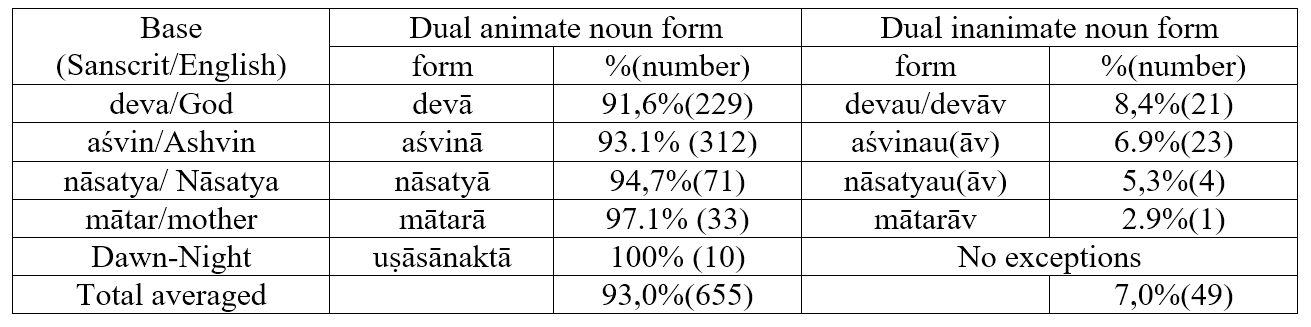
There may indicate the initial stage of abandoning a separate form for animate nouns at the time of Rigveda text compilation.
It means that चन्द्रमस् [candramas] cannot be Moon god or any other animate noun as सूर्या [sūryā]. Mentioning Sun god सूर्य [sūryа] in conjunction with a non-god is inappropriate and is a contradiction in the existing concept of translation. Therefore, the translation needs to be adjusted.
Presumably, it can be argued that since चन्द्रमसौ(आव्) [candramasau(āv)] and चन्द्रमसा [candramasā] occur equally twice in the text V.51.15, X.190.3 and I.102.2, X.64.3, it is unlikely that the variant चन्द्रमसौ(आव्) [candramasau(āv)] is a deviation from the norm and should be ignored, as it happens currently. Since it was clarified above that चन्द्रमसा [candramasā] in X.64.3 is an attribute of the Sun and the Moon, it is clear why it has the ending of an animate noun, then the variant चन्द्रमसौ(आव्) [candramasau(āv)], referring to inanimate nouns, may be related to the month, for example, as a measure of time. We will keep this in mind further considering the problem.
Grammatically, it is acceptable to consider the expression सूर्याचन्द्रमसौ [sūryācandramasau] as सूर्या चन्द्रमसौ [sūryā candramasau] is not a pair in the dual number, which can be translated in two ways:
a. Sūryā (daughter of Sun) two shining changeable.
b. Two Suns – two shining changeable (two Moons/Suns).
Both options are semantically incorrect and cannot be accepted. And the option ‘a.’ is also grammatically unacceptable, since ‘daughter of the Sun’ is expected in the accusative case, and not as it comes out in the nominative one.
Therefore, we will try to solve this problem by this expression presenting as a three-base compound word सूर्य-अचन्द्र-मसौ [sūrya-acandra-masau]. Here the word चन्द्र [candra] has received a negation – अचन्द्र [acandra] – ‘shineless’, ‘Sun’ has received a singular form and the whole expression is only now perceived grammatically correctly, and the entire verse can be translated as ‘Within sunshineless two changes Dhatar as before established the Heaven and the Earth, the space between (them), then the light.’ This translation is grammatically correct without any assumptions. And also in the emerging context, it is possible to determine which from 2 changes is here. Is it the Sun or the Moon? In the absence of the sunshine, the time can be controlled only by the Moon, so in this case, 2 changes are taken as 2 months. Then the final translation of verse X.190.3 will be ‘Within sunshineless two months Dhatar as before established the Heaven and the Earth, the space between (them), then the light.’ As a result, the translation of the verse eliminated the semantic incorrectness of setting the Sun twice. It should be noted that sentences beginning with the time adverb are characteristic of the sentence structure in Sanskrit (for example, in X.68.11 रात्र्यां तमो अदधुर् [rātryāṃ tamo adadhur] - They established darkness at night) which additionally speaks pro accepting this translation.
It is also necessary to check the correspondence of this translation to other verses of this hymn:
X.190.1: ‘Law and truth were born from ignited heat. Out of him was born the night, Out of him the rolling ocean’.
X.190.2: ‘Out of the rolling ocean was born the year, Which distributes days and nights, the Lord of all that blinks’. (by Elizarenkova [8])
Analyzing it, we can conclude that before the birth of a year which distributes days and nights, a certain primal night is born, which may well correspond to two months of sunshineless, and the birth of a year with days and nights corresponds to the light appearance.
Thus, just as two months of darkness, which are night from X.190.1, occur periodically (as before), so the year distributing days and nights from X.190.2 occurs periodically.
It should also be noted that not just the word वत्सर [vatsara] is used for the year, but संवत्सर [saṃvatsara], which can be translated as ‘a full year’.
And since it is not specified which specific years this applies to, it can apply to any year. The fact is that a year is created every year, it does not raise questions, but thus fact that the Heaven and the Earth are restored as before every year causes misunderstanding, since nothing happens to them that is uniquely repeated once a year.
Therefore, let's take a closer look at the verb that अधि अजायत [adhi ajāyata] which is used to describe the year birth– it translates as ‘was created (was born)’, but its variant without the preverb अधि [adhi] is simply अजायत [ajāyata] also translated [1-3,14,22]. Perhaps there is a nuance of missing meaning in the अधि [adhi] preverb.
The preverb ‘adhi’ gives the verb meaning ‘to, from above’ [7, p.258]. To determine how to translate in this case, let us turn to examples of the preverb ‘adhi’ use with other verbs in Rigveda text:
धा [dhā] => अधि-धा [adhi-dhā] – to put => to as-sign (III.29.4)
स्था [sthā] => अधि-स्था [adhi-sthā] – to stand => to as-cend (V.33.3)
कर् [kar] => अधि-कर् [adhi-kar] – to do => to ad-minister
Then अजायत [ajāyata] => अधि-अजायत [adhi-ajāyata] – was born => ad-apt, ad-just, ac-commodate (reborn), where the prefixes ac-, as- are variants of the same prefix ad-. The regular correspondence of the Latin prefix ‘ad-‘ and the Sanskrit prefix ‘adhi-‘ is traced. As a result, we accept the translation of अधि-अजायत [adhi-ajāyata] as ‘was reborn’.
Now it becomes clear the use of the adverb यथापूर्वम् [yathāpūrvam], which has meaning ‘as before’ in the third verse. Because the verb अकल्पयत् [akalpayat] does not carry the meaning of action repetition, but It has the meaning ‘established, prepared’ and therefore a clarification is used with the adverb ‘as before’.
As a result, the hymn translation can be adjusted as follows:
a) Law and truth were reborn from the ignited heat, night was reborn from it, and the ocean was reborn from it.
b) The year has been reborn from the roiling ocean, distributing days and nights, the Lord of all that blinks (mortals).
c) Within sunshineless two months Dhatar as before established the Heaven and the Earth, the space between (them), then the light
Thus, repeated birth is described – rebirth, restoration, or renewal, which is resembling a spring awakening after a cold winter.
In total, this translation does not cause any semantic contradictions in this hymn text and eliminates the existing ones, so it can be accepted before checking other mentions of सूर्याचन्द्रमसौ [sūryācandramasau] in Rigveda text.
8) This narrative finds its parallels in other hymns of Rigveda, for example, in I.102.2 अस्य श्रवो नद्यः सप्त बिभ्रति द्यावाक्षामा पृथिवी दर्शतं वपुः । अस्मे सूर्याचन्द्रमसाभिचक्षे श्रद्धे कम् इन्द्र चरतो वितर्तुरम् [asya śravo nadyaḥ sapta bibhrati dyāvākṣāmā pṛthivī darśataṃ vapuḥ । asme sūryācandramasābhicakṣe śraddhe kam indra carato vitarturam]. Translated by Elizarenkova [8]:
‘His glory is borne by the seven rivers — Heaven-and-Earth, the earth's expanse (they carry) his beautiful appearance. The Sun and the Moon move alternately So we could see (them), so we believed (in you)’.
There is a semantic ambiguity in this translation, so as: द्यावाक्षामा पृथिवी [dyāvākṣāmā pṛthivī], which is translated as Heaven-and-Earth, the earth's expanse, which contain the tautology: ‘Earth, the earth's expanse’, which Sayana also tried to eliminate by suggesting that पृथिवी [pṛthivī] can be considered as the name of the airspace, which is doubtful. Also, neither Geldner: ‘Himmel und Erde, das weite Land’, nor Renou ‘ciel et terre, la terre’ [8, p.602] solved this problem.
And also, in general, the meaning understanding of a verse causes difficulties in terms of semantic interconnection of its parts. Thus, we consider the translation is inconsistent with the accepted semantic criterion and is requiring correction.
This is enough to examine the image of द्यावाक्षामा पृथिवी [dyāvākṣāmā pṛthivī]. Apparently, this द्यावापृथिवी [dyā́vāpṛthivī́] is a stable image, internally oriented, like a double pair, if there is no Earth, then it is quite possible that क्षामा [kṣā́mā] is your representative. In this case, क्षामा [kṣā́mā] will not be able to recognize ‘earth’ and will need to examine its other meanings. We also note that this is exactly the meaning of ‘earth’ in the text, and variants with the usual क्षा [kṣā́]. Let’s consult to the dictionaries [1-3,14,22]. They give the values:
क्ष [kṣa] — f. Ved. The ground, the earth.
क्षा [kṣā] — f. 1) The earth. ([from kṣam] a f. (derived [from] some forms of 2. kṣam) the earth, ground, [Naighaṇṭuka, commented on by Yāska i, 1; Nirukta, by Yāska ii, 2; Sāyaṇa])
क्षम् [kṣam] f. ([nominative case] क्षास् [kṣās], [accusative] क्षाम् [kṣām] [instrumental case] क्षमा [kṣamā] once jmā [Ṛg-veda VI, 52, 15] [dative case] kṣe [? [Ṛg-veda iv, 3, 6]], [genitive case] [ablative] gmas, jmas, once kṣmas [Ṛg-veda I, 100, 15], [locative case] क्षमि [kṣami]; [dual number] [nominative case] क्षामा [kṣāmā] [Ṛg-veda ii, 39, 7; x, 12, 1]; cf. dyāva-kṣāmā; [plural] [nominative case] kṣāmas [Ṛg-veda VIII, 70, 4]; क्षामीस् [kṣāmīs] [from] mi, [Sāma-veda], क्षास् [kṣās] [Ṛg-veda IV, 28, 5] [accusative] क्षास् [kṣās] [Ṛg-veda X, 2, 6] [locative case] क्षासु [kṣāsu], [Ṛg-veda i, 127, 10 and V, 64, 2]) the ground, earth, χθών [Ṛg-veda; Atharva-veda; Vājasaneyi-saṃhitā; Śatapatha-brāhmaṇa VI]
Analyzing the dictionary data, we assume that in this situation, probably, as in the case of मस्। मास् [mas/ mās], the epithet of the name of the object began to be considered its very name.
Therefore, let us also turn to the verbal bases from which क्षा [kṣā] и क्षाम [kṣāma] could be formed. This is the verb क्षै [kṣai] - to wither, wither, deplete, decline, collapse, dry.
Then ‘kṣai’ + ‘i’ => ‘kṣā’ is dried and then ‘kṣā’ + ‘ma’ => ‘kṣāma’ with the same meaning. (where ‘i’ and ‘ma’ are suffixes).
Presumably, maybe क्षा [kṣā] – refers to the ground, क्षाम [kṣāma] – refers to the Earth.
Let's clarify the compound word वितर्तुरम् [vitarturam], which has the translation as ‘alternately’. This is a two-base compound word with the prefix ‘vi-‘, the accusative case ending of the ‘-am’, the fixed form of which can turn into an adverb, which in this case is the case. Thus, this word is divided into the basics [vi-tar(a)-tur-am], तुर् [tur] – rush, speed वि-तर [vi-tara] – leading everything further. What is combined with the control verb चरतो [carato] – car; wander; perform; travel; bore; produce; make; dwell; dig; act; observe; enter (a state); observe; cause; crop; behave; practice; heed; process; administer – can be translated as ‘restore quickly’.
We also use in सूर्याचन्द्रमसौ [sūryācandramasau] adopted division ‘sūrya-a-candra-masau’ and in the सूर्याचन्द्रमसाभिचक्षे [sūryācandramasābhicakṣe] expression, as ‘sūrya-a-candra-mas-a-abhicakṣe’, which can be translated as ‘unobservable wihin sunshineless two months’ and the entire verse translation will take the form
‘The seven rivers display his glory: dried the Heaven and the Earth, which were unobservable within sunshineless two months, quickly restore their beautiful appearance to us who truly believe, oh Indra’.
It should be noted that the मस् [mas] base, being inside a compound word, has no a dual number, therefore, it is formally possible to translate ‘one month’, and both variants are grammatically correct, but according to the received hymn X.190 context, the variant ‘2 months’ is accepted.
This happens because the basics of the dual number are not used in Sanskrit word formations. [19]
Since this is not the unique possible सूर्याचन्द्रमसाभिचक्षे [sūryācandramasābhicakṣe] division, we will consider other variants, but the presented variant is given first, since it is more verse context consistent and revealing its meaning, and therefore was accepted as more appropriate to the semantic criterion.
It is possible to represent सूर्याचन्द्रमसाभिचक्षे [sūryācandramasābhicakṣe] as ‘sūrya-a-candra-masa abhicakṣe’, and then it turns out ‘visible within sunshineless month (or two months)’, but this causes controversy, because nothing is visible in the dark when the Sun is not shining, so this option was rejected on semantic criterion.
It is also possible to represent सूर्याचन्द्रमसाभिचक्षे [sūryācandramasābhicakṣe] as two words 'sūryа-a-candra-masā аbhicakṣe', then the phrase would be दर्शतं वपुः सूर्य-अ-चन्द्र-मसा अभिचक्षे [darśataṃ vapuḥ sūryа-a-candra-masā аbhicakṣe], which can be translated as ‘beautiful appearance visible within two Moons of the sunshineless.’ This translation contains even more contradictions. In addition to observing in the dark when the Sun is not shining, the two Moons also act as goddesses to indicate the time interval when it happens, acting not as the Moon subject, but as a adverb of time. Therefore, this option was rejected based on semantic criterion.
It should also be noted that the assumption that क्षामा [kṣāmā] are withered (dried) has been successfully confirmed, since the seven rivers that bring glory are known to be liberated by Indra and restore the Heaven and the Earth withered in 2 months by their waters, that is why they are mentioned at the beginning of the verse.
It should be noted that the expression द्यावाक्षामा पृथिवी [dyāvākṣāmā pṛthivī] occurs 1 time yet in verse III.8.8, in which क्षामा [kṣāmā] also means ‘withered’. In addition, क्षामा [kṣāmā] without पृथिवी [pṛthivī] occurs 9 more times in verses I.96.5, I.121.11, I.141.13, IV.2.16, VI.31.2, X.12.1, X.36.1, X.45.4, X.176.1 as part of a pair the Heaven and (the Earth) withered, without causing semantic contradictions.
It should be noted that this translation eliminates the supposed ellipticity of the hymn due to the perception of an excessive number of subjects as objects or adverbs. As a result, the hymn acquired a consistent meaning.
9) Let us finally consider the last case of expression सूर्याचन्द्रमसौ [sūryācandramasau] using - this is verse V.51.15: स्वस्ति पन्थाम् अनु चरेम सूर्याचन्द्रमसाव् इव । पुनर् ददताघ्नता जानता सं ग-मेमहि [svasti panthām anu carema sūryācandramasāv iva । punar dadatāghnatā jānatā saṃ ga-memahi]
The translation is as follows:
‘For the good, let us follow the (difficult) path, like 2 months sunshineless! May we meet the giver again, the non-killing one, the understanding one!’
This clarifying translation removes the ambiguity of the existing translation, from which it was not clear exactly who is ‘the giver again, the non-killing one, the understanding one’ was referring to. From the translation received, it becomes clear that it is said about the Sun.
CONCLUSIONS AND FURTHER PROSPECTS OF THE STUDY
1. In view of the existing difficulties in translating the words मस् [mas], मास् [mās], क्षाम [kṣāma] in certain verses of the Rigveda, hypotheses were put forward in the paper that the words मस् [mas], मास् [mās], क्षाम [kṣāma] are nouns formed from verbs with the bases मे- [me-] (to change), मा- [mā- ] (to measure), क्षै- [kṣai-] (to wither), with the corresponding meanings: ‘change’, ‘measure’, ‘dried’, which should be used first of all when we are translating, and only then refine the meaning according to the context. And if the meaning of the month or the Moon is defined for the word मास् [mās] in the Rigveda text, then with the attribute चन्द्र [candra] (चन्द्रमस् [candramas], चन्द्रमास् [candramās]), depending on the context, these words can take on the meanings of ‘Sun’, ‘Moon’, and ‘month’, as well as their original meanings of ‘change’ and ‘measure’.
Also, the existing translations of verses mentioning these words were reviewed for compliance with accepted grammatical and semantic criteria, and if they were violated, adjustments were made to these translations in order to eliminate the discrepancy between the translations and the accepted criteria.
2. New translations of verses were received: X.64.3, X.85.19, I.105.1, VIII.82.8, I.24.10, I.83.15, X.190.3, I.102.2, V.51.15 and the reviewed translation of verse X.90.13 is left unchanged.
Thus, the basics of चन्द्रमस्- [candramas-], चन्द्रमास्- [candramās-] from 10 available mentions have the following meanings:
- ‘The Sun’ is at 40% of cases,
- ‘The Moon’ is at 20%,
- ‘A month’ is at 30%,
- ‘Sun and Moon together’ is at 10%.
But separately:
- चन्द्रमस् [candramas]: 20% cases is Sun and Moon together, 20% cases is the Sun, 60% cases is a month.
- चन्द्रमास् [candramās]: 60% cases is the Sun, 40% cases is the Moon.
3. The suggestion that in the context of द्यावाक्षामा पृथिवी [dyāvākṣāmā pṛthivī] (I.102.2, III.8.8) क्षामा [kṣāmā] has the meaning of ‘withered’, it was successfully confirmed in verse I.102.2 that the text means that the ‘withered’ the Heaven and the Earth are restored by the water of liberated rivers, and this interpretation did not cause contradictions in III.8.8, as well as in other cases of using क्षामा [kṣāmā]: in I.96.5, I.121.11, I.141.13, IV.2.16, VI.31.2, X.12.1, X.36.1, X.45.4, X.176.1
4. Verses X.190.3, I.102.2, V.51.15 reveal a direct reference to the two-month darkness when the Sun does not shine, and also in I.105.1 it says about the absence of the Sun in the sky, which at that time is in the waters, being cleansed, reminiscent of a two-month preparation in the verse 190.3. This darkness resembles the phenomenon of the polar night, which occurs annually in the territories located beyond the Arctic circle. To accept or refute this conclusion, it is necessary to analyze the translation of the hymn X.190 as a whole, and not just its third verse, as was done above.
We should also pay attention to another ‘cosmogonic’ hymn, X.129. Unlike X.190, it longer has no an objective descriptive structure, but rather an evaluative and subjective one. It describes the author's attitude to the events taking place as if the author himself was experiencing them or had been experiencing them. At the same time, the hymn of X.129 is consonant with the hymn of X.190, it also describes the absence of alternation of day and night (X.129.2), and the ‘original night’ is called ‘darkness (तमस् [tamas]) hidden by darkness in the beginning.’ This description can be interpreted as the darkness of the Earth is hidden by the darkness of the Heaven, as ‘a black one on a black one.’ In this hymn, a new term ‘darkness hidden by darkness’ (तम गूऌहम् तमसा [tama gūḷham tamasā]) is appeared, corresponding to the ‘original night’ of hymn X.190, reminiscent of the great, blind, all-encompassing, joyless, hidden, condensed, cloudy, sunless, black, thick, long, expanded, irregular darkness mentioned in other verses of the Rigveda. (I.100.8, I.173.5, II.27.14, II.40.2, IV.1.17, IV.16.4, IV.45.2, V.31.3, V.32.6, V.40.6, VI.21.3, VI.50.10, VII.75.1, VII.78.3, VII.81.1, IX.66.24, X.89.15, X.103.12 X.113.7, X.124.1), as well as many mentions of just darkness. In further research, it is necessary to consider all cases of mentioning darkness (तमस् [tamas]) and to assess what kind of darkness it may relate to, as well as apply the new available context to possibly clarify difficult-to-understand passages of Rigveda.
It should also be noted that the interpretation of the hymn X.190 as cosmogonic apparently arose under the influence of the biblical myth of the world creation [11] in a situation of lack of context understanding. As a result, the translation was adapted to the biblical paradigm, violating the rules of grammar of the language and substituting the meanings of words, considering it as acceptable way in the absence of other reading options.
5. The results which are obtained suggest that despite the unique system of preserving and transmitting the text of the Rigveda from generation to generation without the use of writing, in the oral form, no letter to letter, but sound to sound, the places where the equal sounds merged into one at the junction of words, there was a misunderstanding of this process and the loss of the original meaning, which can be restored by reading the text strictly according to the grammatical rules of the original language, there where is a semantic inconsistency in the text. Although attempts to explain the text of the Rigveda took place in later opuses, they led to the emergence of a new context. For example, perhaps the expression सूर्याचन्द्रमसौ [sūryācandramasau] in ‘śatapatha-brāhmaṇa’ XI.1.5.1 is used as the expression चन्द्रमा अवचन्द्रमसः [candramā avacandramasaḥ] - interpreted as a falling the Moon, whereas according to the terminology revealed in this paper, the literal translation would be: ‘shining measure fading change’, but the original meaning in this expression can no longer be found if you do not know it in advance.
It is possible that such a text arose as an attempt to explain the lost meaning of सूर्याचन्द्रमसौ [sūryācandramasau] phrase. This happened because prose texts were not protected from distortion as well as metrical poetry. And it is precisely this property of the poetic text that allows the researcher to restore an understanding of what was said by the ancient authors. While the commentators of the Rigveda in the past, being native speakers of the Sanskrit language, which has changed since the creation time of the Rigveda, unwittingly applied their modern concepts in Sanskrit to the ancient text of the Rigveda, which as a result was misleading and led to a distorted understanding of the text, since the semantics of the text was evaluated for compliance with their modern language, but not the original language. Then there already was a succession of erroneous understanding, which due to ancient times was already perceived as true.
While guessing about the original meaning of the expression, it can be assumed that at the time of the compilation of ‘śatapatha-brāhmaṇa’ चन्द्रमा [candramā]-word was still used in two meanings, both the Sun and the Moon, but the meaning of the अचन्द्रमसौ [acandramasau]-word was no longer understood and it was replaced by a similar अवचन्द्रमसः [avacandramasaḥ]-word, distorting the original meaning, but more understandable outside the context.
Thus, it can be stated that at the time of the development of the Padapātha (7th - 6th centuries BC), some details of the text were already unrecognizable.
THE EPILOGUE
Having hypothesized the use of the original meaning of the words मस् [mas], मास् [mās], क्षाम [kṣāma] as verbal nouns for semantic revision of translations in order to bring them into accordance with the translation criteria accepted in the paper, new varants of hymn translations with greater semantic integrity were obtained, which reduces the degree of uncertainty in understanding the Rigveda texts. Among other things, the requirement of strict observance of the grammatical norms of Vedic Sanskrit has made possible to identify the previously overlooked context of the work, in particular, the description of the phenomenon of the two-month non-illumination of the Sun., suitable for the realities of the polar night.
Since the new meanings of words obtained as a whole lie in the general outline of previously existing meanings and they are in fact their clarifications and recommendations for their application, it seems unlikely that this hypothesis will be refuted, that it will then refute all the conclusions of this paper based on the hypothesis accepted by the author of the paper. In the resulting context, the translation of the verb अधि अजायत [adhi ajāyata] as ‘was reborn’ looks rather obvious and such a translation was not used earlier solely under the influence of the paradigm of the biblical myth of the creation of the world used as the only attempt to translate, regardless of the alleged violations of the grammatical norms of the original language.
The conclusions of this paper give the opportunity critically to review the provisions and conclusions of B. G. Tilak's theory about the Arctic home in the Vedas [17, pp.461-465]. Apparently, it contains a rational grain, despite the hastily drawn conclusions about the habitation of the ancient Aryans in the Arctic. Although archaeological data from the camps of the ancient inhabitants of the Arctic Region do not find parallels with the camps of the ancestors of the Indo-Aryans and other Indo-European peoples, but this fact does not exclude the possibility of cultural exchange in different areas of vital activity between the ancestors of the Indo-Aryans and their neighboring tribes of other linguistic families representatives living further north. For example, the ancestors of modern Europeans borrowed the ideas of Christianity from representatives of the Semitic language family and propagate them all over the world.
Such cultural exchange can be confirmed by the presence of borrowings in Sanskrit of words from unrelated languages. For example, Vasilkov Ya.V. in [18, p.56] reasonably argues that the borrowings between Proto-Uralic and Proto-Indo—Iranian languages lasted for a huge period of time, perhaps several millennia, beginning with the contacts of an undifferentiated Indo-Iranian (Proto-Aryan) — its Eastern Indo-European dialect with an undifferentiated Proto-Uralic language in the Neolithic period (V — III thousand BC). A number of Proto-Uralic words perhaps have been borrowed by Proto-Aryan, and these borrowings have their own characteristic semantics: they relate mainly to areas of flora and fauna, or they are names of body parts and organs of animals and humans. In the dictionary of the reconstructed Uralic proto-language from Decsy's book [18, p.57; 4], there are words that show great similarity to Sanskrit in both form and meaning, while in Sanskrit (and in general on Indo-European material) the corresponding words are not etymologized.
Thus, if contacts between speakers of Proto-Uralic and Proto-Indo-Iranian languages took place during the V — III millennia BC, then the greatest creation of the cultural heritage of the Indian people, the Rigveda, could possibly have resulted from the traditions of the northern neighbors perceived by the ancestors of the Indo-Aryans.
Further research will be aimed at development of the approach application used in the paper to uncover other currently overlooked aspects of understanding the Rig Veda text.
REFERENCES
1. Apte, Vaman Shivaram. Revised and enlarged edition of Prin. V. S. Apte's The practical Sanskrit-English dictionary. Poona: Prasad Prakashan, 1957-1959. 3v.
2. Bhaṭṭācārya, J. V. (1900). A comprehensive Sanskrit-English lexicon: chiefly based on Professor Horace Hayman Wilson's Sanskrit-English Dictionary and compiled from various recent authorities for the use of schools and colleges. Calcutta, Calcutta Press.
3. Cappeller, C. (1891). A Sanskrit-English dictionary: based upon the St. Petersburg lexicons. Strassburg, Trübner.
4. Decsy G. The Uralic Protolanguage: A Comprehensive Reconstruction. Bloomington, 1990.
5. Der Rigveda In Auswahl Geldner Von Karl F., Erster Teil Glossar Stuttgart Druck Und Verlag Von W. Kohlhammer 1907
6. Edgerton, F. (1953). Buddhist hybrid sanskrit grammar and dictionary 2. 2. New Haven, Yale Univ. Press
7. Elizarenkova T. Ya. Grammar of the Vedic language. Moscow: Nauka Publishing House, Main Editorial Office of Oriental Literature, 1982. – 430 p. (Елизаренкова Т. Я. Грамматика ведийского языка. М.: Издательство ‘Наука’, Главная редакция восточной литературы, 1982. – 430 с.)
8. Elizarenkova T. Ya. Rigveda. [In 3 vol.]. (Series ‘Literary monuments’). Moscow: Nauka, 1989-99. (Елизаренкова Т. Я. Ригведа. [В 3 т.]. (Серия ‘Литературные памятники’). М.: Наука,1989-99.)
9. Elizarenkova T.Ya. ‘Rigveda’ – the great beginning of Indian literature and culture // Rigveda. Mandalas I–IV. Ed. edited by T.Ya.Elizarenkova. – M.: Nauka, 1989. – pp. 426-543. (Елизаренкова Т.Я. ‘Ригведа’ – великое начало индийской литературы и культуры // Ригведа. Мандалы I–IV. Изд. подг. Т.Я.Елизаренкова. – М.: Наука, 1989. – С. 426–543.)
10. Griffith Ralph T.H. The Hymns of the Rigveda 1889–92
11. Holly Bible. Genesys. Chap.1 (Electronic resource) https://azbyka.ru/biblia/?Gen.1&a
12. Jamison Stephanie W. and Brereton Joel P.,The Rigveda. The earliest religious Poetry of India. 2014, 3-volume set published by Oxford University Press (ISBN 978-0-19-937018-4). Funded by the United States' National Endowment for the Humanities in 2004.
13. Klein E. Klein's Comprehensive Etymological Dictionary Of The English Language, 1971
14. Monier-Williams, M. (1899). A Sanskrit-English dictionary: Etymologically and philologically arranged with special reference to Cognate indo-european languages. Oxford, The Clarendon Press.
15. Oldenberg, Hermann (1894). Hymnen des Rigveda. 1. Teil: Metrische und textgeschichtliche Prolegomena. Berlin 1888. (please add), Wiesbaden 1982.
16. Renou Louis “Études védiques et pāṇinéennes” 1955–69
17. Tilak Bâl Gangâdhar “The arctic home in thevedas”. Publishers Messrs. TILAK BROS. Gaikwar Wada, POONA CITY. 1925.
18. Vasilkov Ya. V. From the field of Aryan-Uralic cultural and linguistic contacts. // ‘Bulletin of the Mordovian University’, Saransk. 1999. No. 3-4, pp. 56-63. (Васильков Я. В. Из области арийско-уральских культурно-языковых контактов. // ‘Вестник Мордовского университета’, Саранск. 1999. №3-4, с. 56-63.)
19. Vorobyev-Desyatovsky V.S. “The development ofpersonal pronouns in Indo-Aryan languages” Institute of Oriental Studies, Publishing Houseof theUSSR Academyof Sciences, Moscow. - Leningrad, 1956, p. 46 (Воробьев-Десятовский В. С., ‘Развитие личных местоимений в индоарийских языках.’, Институт Востоковедения, Издательство Академии Наук СССР, Москва. - Ленинград, 1956, стр. 46)
20. Whitney William Dwight. Sanskrit grammar. Including both the Classical Language, and the older Dialects, ofveda and Brahmana. Cambridge, Massachusetts Harvard University Press London: Geoffrey Cumberlege Oxford University Press, 1950
21. Wilson H. H. Ṛig-Veda-Sanhitā: A Collection of Ancient Hindu Hymns 1850–88
22. Yates, W. (1846). A dictionary in Sanscrit and English: designed for the use of private students and of Indian colleges and schools. Calcutta, Printed at the Baptist Mission Press.
[1] Here and further along the text, unless otherwise indicated, the remark in the M.H.V format means a reference to the Rigveda text, where M is the mandala number, H is the hymn number, V is the verse number.